MEXC Digest #37: The Patience Premium

Faith isn't dead on Wall Street. Excitement still matters, but certainty pays better.


Stay Updated

Follow us on Telegram to be notified whenever a new digest drops.


[Follow MEXC on Telegram]{https://t.me/MEXC_OfficialAnnouncements}


New and Noteworthy

The Future Is Walking In. Robots that walk. AI that thinks. This week's Pre-IPO lineup reads like a sci-fi shopping list, from Unitree's humanoid robots to KIMI's AI models. Tomorrow's tech, available for pre-order.


Pizza, Wings, and Wall Street. Domino's (DPZ), Wingstop (WING), and Chili's parent Brinker (EAT). This week's lineup is basically a Friday night takeout order that also happens to trade on the Nasdaq.


[Get Early Access]{https://www.mexc.com/announcements/new-listings}


Five Things You Need to Know

AI development doesn't take a breather. Chinese open-weight models kept closing the gap on their U.S. rivals, now hitting roughly 70% of top-tier performance at a fraction of the cost. Cheaper models mean more developers building on them, and more demand across the board.


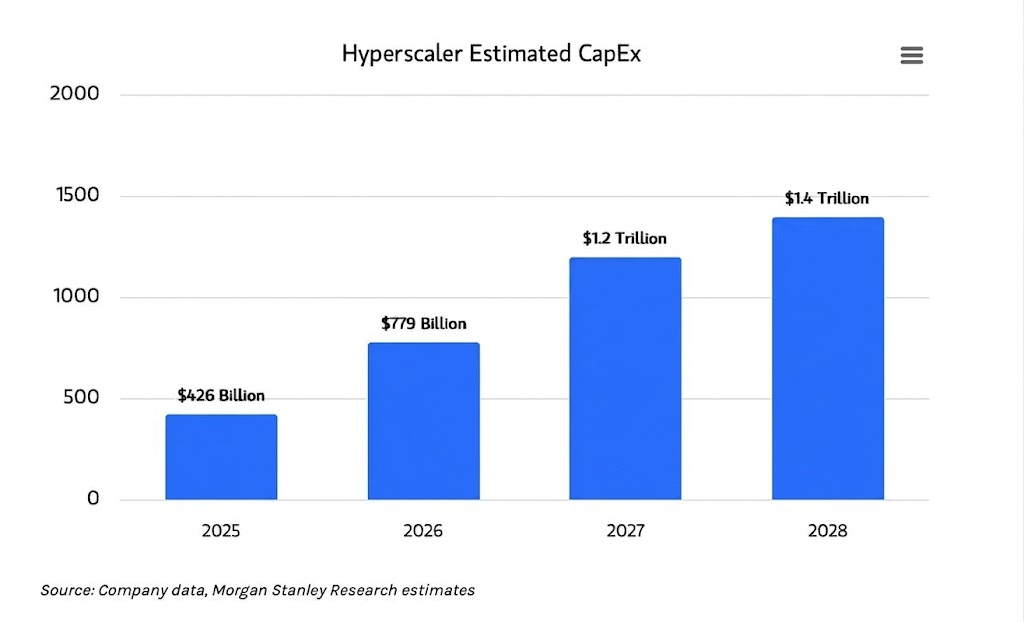
Institutions are still bullish. Morgan Stanley Head of Research Stephen Byrd is calling this the "intelligence superhighway," a phrase that sounds like it was coined at a rest stop somewhere in 1998. Byrd sees hyperscalers still early in a multi-year buildout. But even he's flagging key speed bumps ahead.


The market seems to agree those bumps are real. AI infrastructure stocks slid this week, not because anyone doubts demand, but because investors are starting to ask the harder question: will this spending actually pay off?

There are reasons to stay optimistic. Major labs are pushing toward recursive self-improvement, where models start helping build the next generation of themselves. Hyperscaler capex estimates keep climbing too. Even the bottlenecks tell a growth story: some bitcoin miners are pivoting away from crypto entirely, repurposing their power infrastructure to become data center providers for AI instead. So the bulls and the skeptics are both right. AI's getting better. The key question is whether the returns can keep pace.


Political gridlock may be exactly what markets want. Markets hate uncertainty. Turns out they're fine with paralysis, as long as it's the predictable kind.


US midterms are still three months away, and plenty can change before voters head to the polls. But investors are already looking beyond campaign headlines to what comes after. Democrats are currently favored to regain the House, while control of the Senate remains highly competitive. With neither party likely to secure a clear governing mandate, the prospect of divided government is back on investors' radar. History suggests that when Congress is split from the White House, sweeping legislative changes become harder to pass. Fewer policy surprises can make that outcome surprisingly reassuring for markets.


Defense, financial services, and big tech could be the winners if that split materializes. Fewer regulatory curveballs, a calmer runway to operate on. Clean energy, healthcare and pharma, and digital assets have less to celebrate, since their agendas tend to need real legislative momentum, and gridlock has a way of stalling exactly that.


Wall Street rewards consistency over excitement. One theme kept showing up this earnings season. Strong results no longer guarantee a stock pop. SanDisk was the latest to learn that lesson. The company beat estimates handily, and shares still took a hit once guidance came in soft. A year ago, that kind of beat would have sent the stock soaring. This year, investors wanted the sequel, not the trailer.


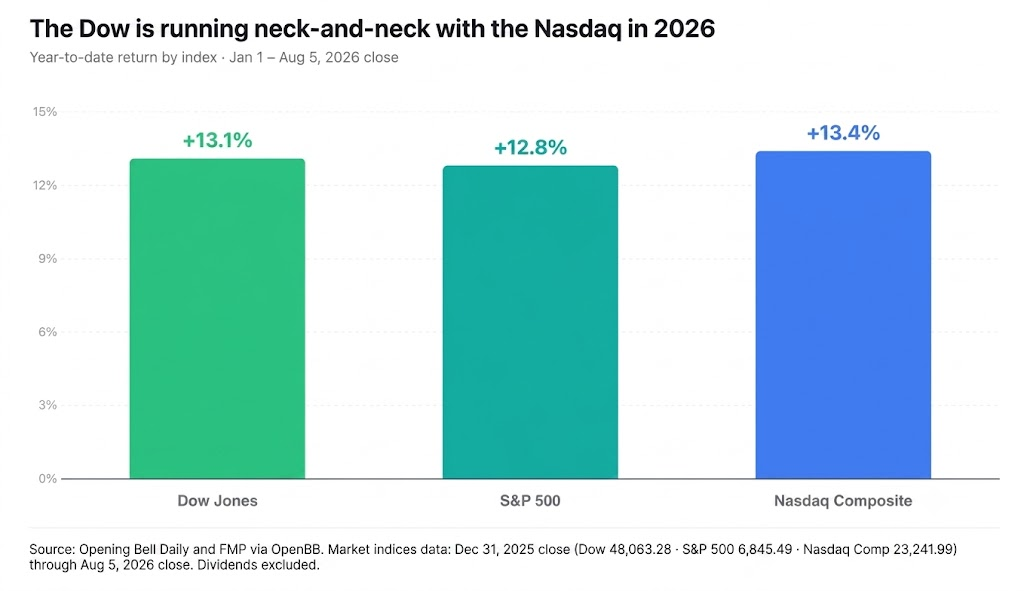
Meanwhile the boring stuff keeps winning. The Dow notched its fifth straight winning day this week, crossing 54,000 for the first time and pulling ahead of the S&P 500 on the year. Thirty unglamorous blue chips, quietly keeping pace with tech.


Some of that resilience has a less comfortable explanation. Big Tech has effectively doubled its debt load over the past five years, adding roughly $350 billion to fund the AI buildout, according to Bloomberg. The bet is that the spending pays for itself eventually. Investors are still funding it, but they're no longer assuming it's a sure thing. AMD doubled its data center revenue this quarter and still dropped 7%. Meta and Apple both beat estimates and got punished on margin worries anyway. Exceptional stopped being the bar. Flawless is now, and even flawless has quit being enough some weeks.


None of this means investors have soured on AI or innovation. They've just gotten pickier about what they're willing to pay for a good story versus a proven one.


Crypto is becoming more mature, even if enthusiasm hasn't returned. Crypto had a mixed week. Progress on one front, cold water on another.


The Clarity Act isn't dead, but Polymarket traders now put its odds of becoming law this year at just 13%, a record low, with the Senate set to recess on August 10 without a scheduled vote. So much for the summer deadline crypto lobbyists were hoping for.


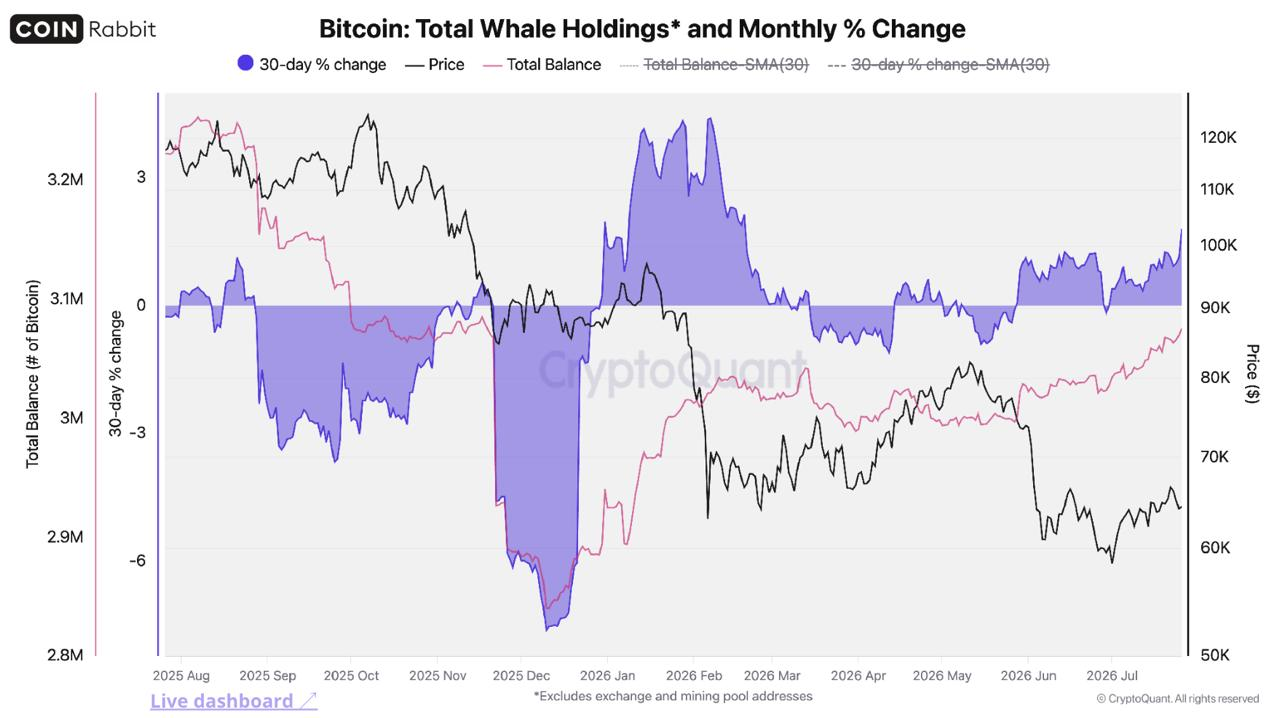
On-chain, the picture is a little more interesting. Bitcoin whale wallets, the ones holding coins outside exchanges and mining pools, have climbed to 3.06 million BTC, up from a December low of 2.87 million, according to CryptoQuant. That's the kind of quiet accumulation that historically shows up near the tail end of a bear market. But don't mistake it for a crowd rushing back in. Glassnode's own read on demand tells a colder story: spot buying pressure across exchanges has stayed negative for weeks, and ETF outflows haven't fully reversed. The whales are stocking up. Everyone else is still sitting on their hands.


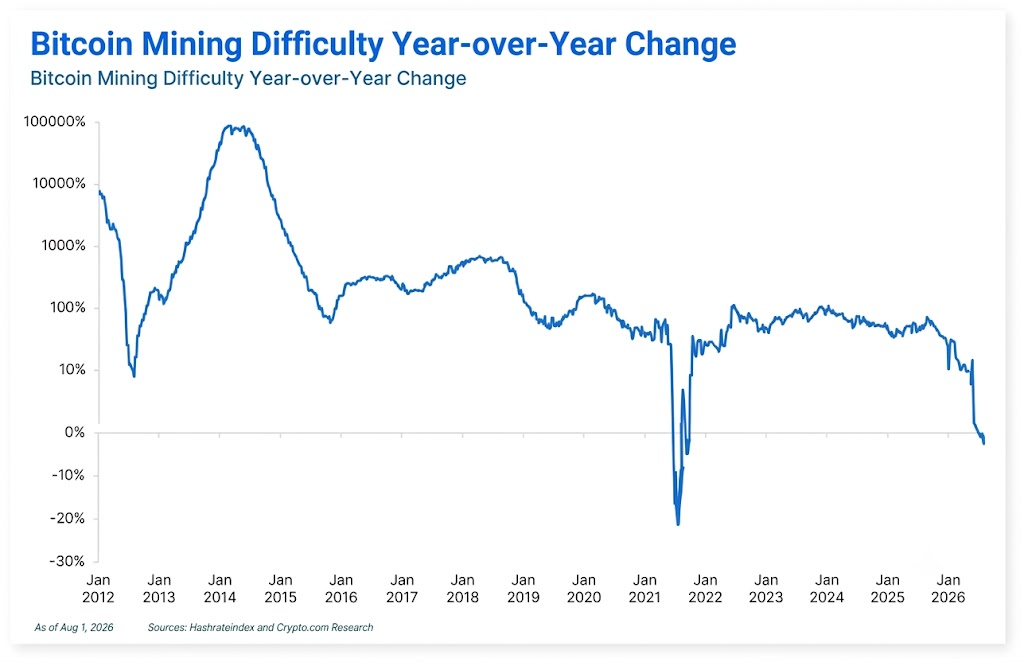
Mining tells its own version of the same story. Bitcoin's difficulty has fallen nearly 20% from its November peak, only the second year-over-year decline in the network's history outside of China's 2021 mining ban. Miners are leaving not because the network broke, but because the math stopped working. Public miners sold a record amount of Bitcoin this year and started leasing their power to AI data centers instead. Some, like Bitfarms, have said outright they're no longer really Bitcoin companies. They're power companies that happen to have mining rigs lying around.


And because crypto can't resist a callback: memecoins are back too. Uniswap launched its own token launchpad, Pools.trade, on Robinhood's new blockchain this week. Within hours, traders had already piled into a token literally named after Uniswap's own teaser video. Robinhood Chain has quietly overtaken Base in daily active users, driven almost entirely by memecoin trading rather than the tokenized-stock use case it was actually built for.


Investors are happy to wait. Call it a stalemate, not a hold. Kevin Warsh's Fed voted 9-3 on July 29 to keep rates steady, the most divided FOMC decision in a decade. Three regional presidents wanted a hike instead. Warsh's clipped, data-light communication style did nothing to reassure anyone he's serious about inflation, and JPMorgan has already moved its hike call up to December. Meanwhile the Treasury sold euros to help Japan defend a yen sitting near a 40-year low. Two separate moves, one signal: policy is getting harder to forecast, not easier.


Friday's jobs report lands into that uncertainty without resolving it. Economists expect payrolls to rise somewhere between 75,000 and 120,000 for July, with unemployment holding near 4.2 to 4.3%. A number in that range confirms what everyone already assumes. A miss reopens the December-hike debate entirely.


SpaceX turned into a live demonstration of how little control companies have over their own headlines this earnings season. Revenue beat estimates by a wide margin. The stock still fell more than 10%, spooked by AI capex, the same reflex that's hit AMD, Meta, and Apple. Two days later, 911.5 million insider shares came off lockup, one of the largest unlock events on record. The stock rose 6%. Neither number was really about SpaceX's business. Both were about what investors decided to be afraid of that day.


Unpopular Opinion

Boredom might be Bitcoin's most bullish signal. Late July delivered a stress test most assets wouldn't survive. A five-year-old firmware flaw in Coldcard hardware wallets let an attacker guess supposedly random seed phrases, draining 594 BTC in the first wave and growing to roughly 1,367 BTC across subsequent waves as researchers kept finding more exposed wallets. Around the same window, a wallet that had sat untouched since 2013 suddenly moved 500 BTC, one of several old-coin reactivations in the same stretch. Add lingering questions about how a supposedly tamper-proof device could fail so quietly for years, and you've got the ingredients for a proper panic.


Bitcoin's reaction: a dip from about $65,000 to $63,000. Not nothing, but nowhere near what headlines like these would have triggered a few cycles ago.


There are two ways to read that. One is that the market has genuinely matured, that deeper liquidity and steadier long-term holders can now absorb a shock that used to cascade. The other is less flattering: Bitcoin's been grinding through a rough year already, down around a quarter since January, and a beaten-down market with thin conviction has less room to react to anything, good news included. Boredom born of resilience and boredom born of exhaustion look identical on a price chart.


Either way, the fact that neither explanation produced a selloff is itself the story. Sometimes the absence of a reaction says more than the headline ever could.


One Surprising Number
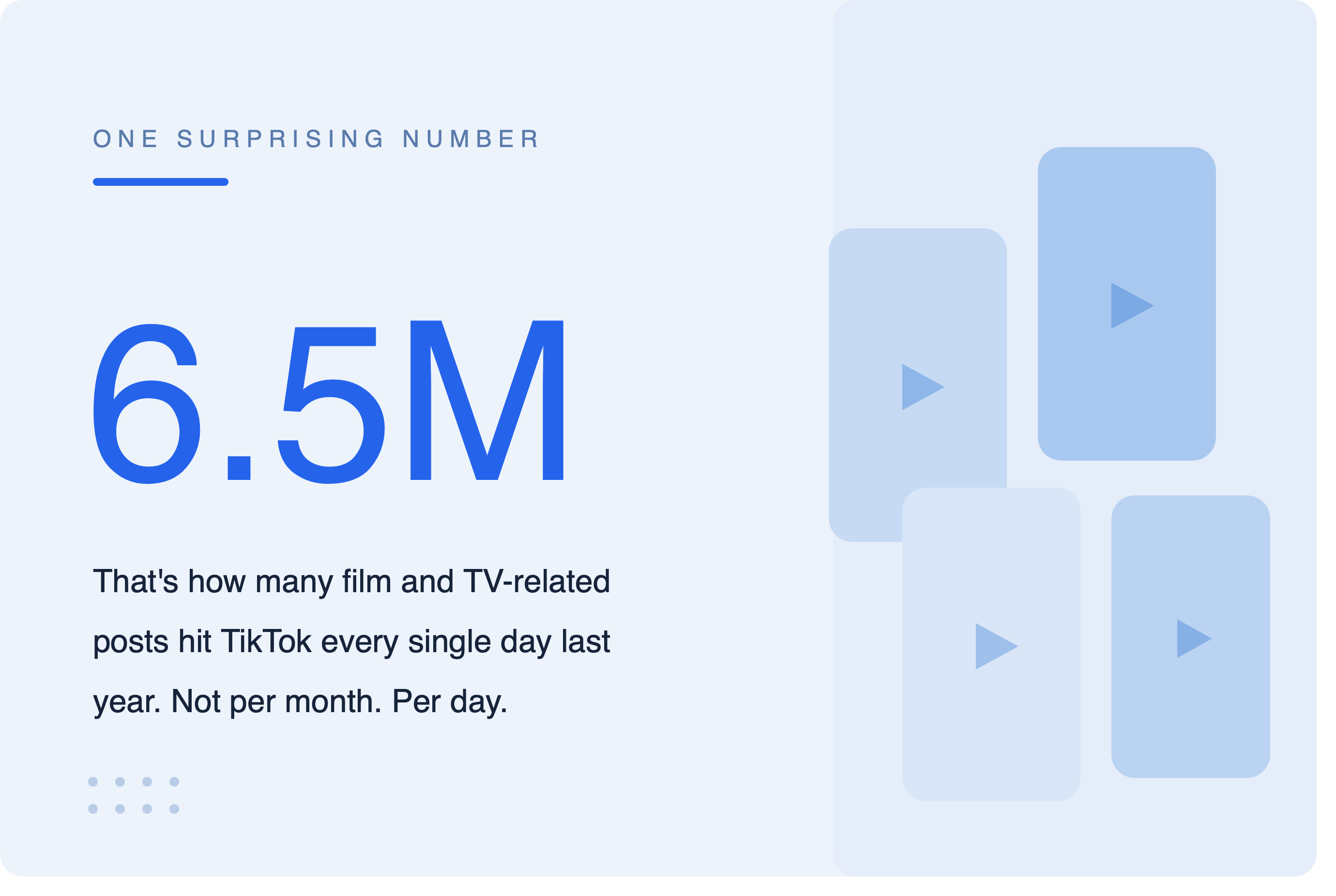
6.5 million.

That's how many Film and TV-related posts hit TikTok every single day last year. Not per month. Per day.

No wonder Disney just struck a deal letting creators officially remix scenes from Marvel, Pixar, and Star Wars, with the best clips landing right inside Disney+.


Translation: the fans were making the content anyway. Disney just decided to stop fighting it and start distributing it.


Before You Go

Markets may be rewarding patience this week. Your trading account doesn't have to be quite so patient.

0808 is officially live, and true to form, it runs on 0 Fees and Infinite Opportunities. Stock Season kicks it off with $500,000 up for grabs and enough trading challenges to keep your watchlist busy all weekend.


[Trade Wall Street]{https://www.mexc.com/announcements/article/mexc-0808-17827791537298}


Certainty is back in fashion. Showing up still pays.

Coin Icon
Sign up now to receive 10,000 USDT in new user rewards

Subscribe to MEXC Digest

Weekly market moves, listings & insights, straight to your inbox.
By subscribing, you agree to receive MEXC newsletters and email updates, and to our Privacy Policy. The content provided is for informational purposes only and does not constitute investment advice.

Join MEXC on Telegram

Get the latest listings, events, and updates in real time, straight from our official Telegram channel.

MEXC Digest #37: The Patience Premium

Faith isn't dead on Wall Street. Excitement still matters, but certainty pays better.


Stay Updated

Follow us on Telegram to be notified whenever a new digest drops.


[Follow MEXC on Telegram]{https://t.me/MEXC_OfficialAnnouncements}


New and Noteworthy

The Future Is Walking In. Robots that walk. AI that thinks. This week's Pre-IPO lineup reads like a sci-fi shopping list, from Unitree's humanoid robots to KIMI's AI models. Tomorrow's tech, available for pre-order.


Pizza, Wings, and Wall Street. Domino's (DPZ), Wingstop (WING), and Chili's parent Brinker (EAT). This week's lineup is basically a Friday night takeout order that also happens to trade on the Nasdaq.


[Get Early Access]{https://www.mexc.com/announcements/new-listings}


Five Things You Need to Know

AI development doesn't take a breather. Chinese open-weight models kept closing the gap on their U.S. rivals, now hitting roughly 70% of top-tier performance at a fraction of the cost. Cheaper models mean more developers building on them, and more demand across the board.


Institutions are still bullish. Morgan Stanley Head of Research Stephen Byrd is calling this the "intelligence superhighway," a phrase that sounds like it was coined at a rest stop somewhere in 1998. Byrd sees hyperscalers still early in a multi-year buildout. But even he's flagging key speed bumps ahead.


The market seems to agree those bumps are real. AI infrastructure stocks slid this week, not because anyone doubts demand, but because investors are starting to ask the harder question: will this spending actually pay off?

There are reasons to stay optimistic. Major labs are pushing toward recursive self-improvement, where models start helping build the next generation of themselves. Hyperscaler capex estimates keep climbing too. Even the bottlenecks tell a growth story: some bitcoin miners are pivoting away from crypto entirely, repurposing their power infrastructure to become data center providers for AI instead. So the bulls and the skeptics are both right. AI's getting better. The key question is whether the returns can keep pace.


Political gridlock may be exactly what markets want. Markets hate uncertainty. Turns out they're fine with paralysis, as long as it's the predictable kind.


US midterms are still three months away, and plenty can change before voters head to the polls. But investors are already looking beyond campaign headlines to what comes after. Democrats are currently favored to regain the House, while control of the Senate remains highly competitive. With neither party likely to secure a clear governing mandate, the prospect of divided government is back on investors' radar. History suggests that when Congress is split from the White House, sweeping legislative changes become harder to pass. Fewer policy surprises can make that outcome surprisingly reassuring for markets.


Defense, financial services, and big tech could be the winners if that split materializes. Fewer regulatory curveballs, a calmer runway to operate on. Clean energy, healthcare and pharma, and digital assets have less to celebrate, since their agendas tend to need real legislative momentum, and gridlock has a way of stalling exactly that.


Wall Street rewards consistency over excitement. One theme kept showing up this earnings season. Strong results no longer guarantee a stock pop. SanDisk was the latest to learn that lesson. The company beat estimates handily, and shares still took a hit once guidance came in soft. A year ago, that kind of beat would have sent the stock soaring. This year, investors wanted the sequel, not the trailer.


Meanwhile the boring stuff keeps winning. The Dow notched its fifth straight winning day this week, crossing 54,000 for the first time and pulling ahead of the S&P 500 on the year. Thirty unglamorous blue chips, quietly keeping pace with tech.


Some of that resilience has a less comfortable explanation. Big Tech has effectively doubled its debt load over the past five years, adding roughly $350 billion to fund the AI buildout, according to Bloomberg. The bet is that the spending pays for itself eventually. Investors are still funding it, but they're no longer assuming it's a sure thing. AMD doubled its data center revenue this quarter and still dropped 7%. Meta and Apple both beat estimates and got punished on margin worries anyway. Exceptional stopped being the bar. Flawless is now, and even flawless has quit being enough some weeks.


None of this means investors have soured on AI or innovation. They've just gotten pickier about what they're willing to pay for a good story versus a proven one.


Crypto is becoming more mature, even if enthusiasm hasn't returned. Crypto had a mixed week. Progress on one front, cold water on another.


The Clarity Act isn't dead, but Polymarket traders now put its odds of becoming law this year at just 13%, a record low, with the Senate set to recess on August 10 without a scheduled vote. So much for the summer deadline crypto lobbyists were hoping for.


On-chain, the picture is a little more interesting. Bitcoin whale wallets, the ones holding coins outside exchanges and mining pools, have climbed to 3.06 million BTC, up from a December low of 2.87 million, according to CryptoQuant. That's the kind of quiet accumulation that historically shows up near the tail end of a bear market. But don't mistake it for a crowd rushing back in. Glassnode's own read on demand tells a colder story: spot buying pressure across exchanges has stayed negative for weeks, and ETF outflows haven't fully reversed. The whales are stocking up. Everyone else is still sitting on their hands.


Mining tells its own version of the same story. Bitcoin's difficulty has fallen nearly 20% from its November peak, only the second year-over-year decline in the network's history outside of China's 2021 mining ban. Miners are leaving not because the network broke, but because the math stopped working. Public miners sold a record amount of Bitcoin this year and started leasing their power to AI data centers instead. Some, like Bitfarms, have said outright they're no longer really Bitcoin companies. They're power companies that happen to have mining rigs lying around.


And because crypto can't resist a callback: memecoins are back too. Uniswap launched its own token launchpad, Pools.trade, on Robinhood's new blockchain this week. Within hours, traders had already piled into a token literally named after Uniswap's own teaser video. Robinhood Chain has quietly overtaken Base in daily active users, driven almost entirely by memecoin trading rather than the tokenized-stock use case it was actually built for.


Investors are happy to wait. Call it a stalemate, not a hold. Kevin Warsh's Fed voted 9-3 on July 29 to keep rates steady, the most divided FOMC decision in a decade. Three regional presidents wanted a hike instead. Warsh's clipped, data-light communication style did nothing to reassure anyone he's serious about inflation, and JPMorgan has already moved its hike call up to December. Meanwhile the Treasury sold euros to help Japan defend a yen sitting near a 40-year low. Two separate moves, one signal: policy is getting harder to forecast, not easier.


Friday's jobs report lands into that uncertainty without resolving it. Economists expect payrolls to rise somewhere between 75,000 and 120,000 for July, with unemployment holding near 4.2 to 4.3%. A number in that range confirms what everyone already assumes. A miss reopens the December-hike debate entirely.


SpaceX turned into a live demonstration of how little control companies have over their own headlines this earnings season. Revenue beat estimates by a wide margin. The stock still fell more than 10%, spooked by AI capex, the same reflex that's hit AMD, Meta, and Apple. Two days later, 911.5 million insider shares came off lockup, one of the largest unlock events on record. The stock rose 6%. Neither number was really about SpaceX's business. Both were about what investors decided to be afraid of that day.


Unpopular Opinion

Boredom might be Bitcoin's most bullish signal. Late July delivered a stress test most assets wouldn't survive. A five-year-old firmware flaw in Coldcard hardware wallets let an attacker guess supposedly random seed phrases, draining 594 BTC in the first wave and growing to roughly 1,367 BTC across subsequent waves as researchers kept finding more exposed wallets. Around the same window, a wallet that had sat untouched since 2013 suddenly moved 500 BTC, one of several old-coin reactivations in the same stretch. Add lingering questions about how a supposedly tamper-proof device could fail so quietly for years, and you've got the ingredients for a proper panic.


Bitcoin's reaction: a dip from about $65,000 to $63,000. Not nothing, but nowhere near what headlines like these would have triggered a few cycles ago.


There are two ways to read that. One is that the market has genuinely matured, that deeper liquidity and steadier long-term holders can now absorb a shock that used to cascade. The other is less flattering: Bitcoin's been grinding through a rough year already, down around a quarter since January, and a beaten-down market with thin conviction has less room to react to anything, good news included. Boredom born of resilience and boredom born of exhaustion look identical on a price chart.


Either way, the fact that neither explanation produced a selloff is itself the story. Sometimes the absence of a reaction says more than the headline ever could.


One Surprising Number

6.5 million.

That's how many Film and TV-related posts hit TikTok every single day last year. Not per month. Per day.

No wonder Disney just struck a deal letting creators officially remix scenes from Marvel, Pixar, and Star Wars, with the best clips landing right inside Disney+.


Translation: the fans were making the content anyway. Disney just decided to stop fighting it and start distributing it.


Before You Go

Markets may be rewarding patience this week. Your trading account doesn't have to be quite so patient.

0808 is officially live, and true to form, it runs on 0 Fees and Infinite Opportunities. Stock Season kicks it off with $500,000 up for grabs and enough trading challenges to keep your watchlist busy all weekend.


[Trade Wall Street]{https://www.mexc.com/announcements/article/mexc-0808-17827791537298}


Certainty is back in fashion. Showing up still pays.

Coin Icon
Sign up now to receive 10,000 USDT in new user rewards

Subscribe to MEXC Digest

Weekly market moves, listings & insights, straight to your inbox.
By subscribing, you agree to receive MEXC newsletters and email updates, and to our Privacy Policy. The content provided is for informational purposes only and does not constitute investment advice.

Join MEXC on Telegram

Get the latest listings, events, and updates in real time, straight from our official Telegram channel.
Stay up-to-date on the latest MEXC listings, delistings, trading events, and product updates. Discover new tokens, Launchpad projects, Earn opportunities, AI-powered tools, and futures trading enhancements on the MEXC platform.Stay up-to-date on the latest MEXC listings, delistings, trading events, and product updates. Discover new tokens, Launchpad projects, Earn opportunities, AI-powered tools, and futures trading enhancements on the MEXC platform.