Robinhood Chain is emerging as one of the most notable blockchain ecosystems of 2026. Unlike many Layer 2s that launch with narratives centered around speed, low transaction fees, or incentive farming, Robinhood Chain comes with a relatively different thesis: bringing traditional financial markets, crypto, and Real-World Assets (RWA) together on the same onchain platform.
What makes this particularly interesting is that although the ecosystem has only been live for nearly two months, it has been growing rapidly, partly because of the company behind it, Robinhood, in a way similar to how Coinbase built Base.
Key TakeAways:
Robinhood Chain is a Layer 2 built on Arbitrum, bringing tokenized stocks, RWA, and DeFi onto the same onchain infrastructure.
Robinhood has massive distribution with 28.4 million funded accounts, while 92% of its revenue comes from non-crypto segments.
Base is proof of the first-mover advantage, controlling nearly half of total L2 TVL after two years.
Robinhood Chain is currently at a stage similar to Base during its first year, leaving significant room for early ecosystem projects to grow.
Several leading dapps have already emerged, including CASHCAT, UP, Arcus, PONS, StonkBrokers, $INDEX, and more.
1. Why Is the Opportunity to Find Hidden Gems on Robinhood Chain So Large?
1.1 What Is Robinhood Chain Building?
Robinhood Chain is an Ethereum Layer 2 built using Arbitrum Orbit and compatible with the EVM. After going through a testnet phase beginning in February 2026, the chain officially launched its mainnet in July 2026.
However, the most important part is not the Layer 2 technology itself, but how Robinhood is positioning it. Instead of building a general-purpose blockchain for every type of crypto application, Robinhood wants to build an onchain financial ecosystem where stocks, crypto, RWA, and other financial products can operate on the same infrastructure. Four key pieces have already emerged from the beginning:
Tokenized Stocks: Stocks and ETFs are brought onchain in tokenized form, allowing them to be traded and integrated with DeFi applications.
DeFi & Lending: Robinhood Earn brings lending and yield activities directly into the ecosystem.
Perpetual Futures: Expanding onchain trading beyond crypto into other types of financial assets.
AI & Agentic Trading: Moving toward a future where AI agents can independently execute trading, swapping, and lending activities onchain.
In other words, Robinhood Chain does not simply want to become another place to trade tokens. The larger thesis is to turn more and more financial activities into onchain primitives that can be freely combined with one another.
What gives this thesis real weight is that Robinhood already has a massive distribution network, with 28.4 million funded accounts and 4.2 million Gold subscribers. Even if only a small portion of these users move toward onchain products, Robinhood Chain does not have to build its user base from zero like most new blockchains. This is an advantage that very few Layer 2s can match.
The early data also supports this thesis. Just a few weeks after mainnet, the chain was already recording millions of transactions per day, while TVL and the number of active accounts continued to increase.
In short, the Robinhood Chain thesis is not simply about having another Layer 2. It is about leveraging an existing user base, assets, and financial ecosystem to bring traditional finance onchain. If this model succeeds, the value will not only accrue to the chain itself, but also flow down to DEXs, lending protocols, perp DEXs, RWA platforms, and the native dapps building on the ecosystem at an early stage.
1.2. The Growth of Base Over the Years
Base launched its mainnet in August 2023. At the time, most of the market viewed it as simply "another L2 from Coinbase." Two years later, the numbers tell the whole story:
Controls 46.6% of total L2 DeFi TVL, nearly half of the entire L2 market.
Bridged TVL reached $13.07 billion.
More than 660,000 DAU, processing around 60% of total Ethereum L2 transactions.
Sequencer revenue reached $75.4 million in 2025, up 30x from the previous year and accounting for 62% of total L2 revenue globally.
Around $8.5 billion worth of stablecoins and cbBTC are already sitting on the chain without being deployed into DeFi, representing liquidity that is ready to flow into the ecosystem at any time.
Hundreds of native projects have reached valuations of hundreds of millions of dollars or more.
Base's formula is very simple: distribution beats tech. Coinbase has 120 million verified users, and once the door to onchain was opened, users naturally flowed in.
Robinhood Chain is playing the same game, but it has an even stronger card: Stock Tokens. Base has cbBTC, while Robinhood Chain has tokenized NVDA that can be used as collateral in lending pools. This is something Base cannot simply replicate because Robinhood already has the licenses and infrastructure required to issue tokenized equities legally, creating a regulatory barrier that no other blockchain can easily overcome.
The lesson for hidden gem hunting is clear: early native projects on Base such as Aerodrome, Friendtech, Virtual, and early memecoin launchpads generated massive returns for early participants before the ecosystem became widely known. Robinhood Chain is currently at a similar stage to Base during its first year: liquidity is still relatively thin and there are still only a limited number of projects, but this is also the stage where investors can potentially find projects capable of delivering hundreds of times in growth, just as Base did.
2. Quick Comparison: Robinhood/Robinhood Chain vs Coinbase/Base
Rather than comparing TVL or volume, which would be somewhat misleading since Robinhood Chain has been live for less than two months, what matters more for investors is the scale of the two companies behind these ecosystems and how they position their respective chains over the long term.
When Base launched in August 2023, Coinbase was already a highly successful crypto exchange with more than 120 million verified users and billions of dollars in crypto revenue. However, Base had essentially one main pipeline: crypto users moving onchain. Robinhood Chain has multiple pipelines, which means the potential for Robinhood-native versions of projects such as Virtual, Aerodrome, Brett, and others could be significantly larger.
2.1 Coinbase: A Highly Successful Crypto Exchange
Coinbase is the king of crypto, and there is little need to debate that. In 2025, total revenue reached $7.18 billion, up 9% year over year, while total trading volume increased 156% to $5.2 trillion and crypto trading market share doubled. Coinbase also completed its acquisition of Deribit for approximately $2.9 billion, strengthening its position in the crypto options market.
However, looking at the revenue structure reveals a clear limitation: transaction revenue accounted for around 60% of total revenue, or more than $4.3 billion, making it heavily dependent on crypto trading volume. Subscription & services contributed $2.83 billion, mainly from the USDC stablecoin and staking, meaning the business still largely remains within the crypto ecosystem rather than expanding meaningfully into traditional finance.
Base is therefore a natural extension of a crypto company, with a primary pipeline consisting of crypto traders moving onto Base.
2.2 Robinhood: A Financial Super-App Expanding Its Reach
Robinhood is not simply a crypto exchange. It is a combination of multiple financial businesses operating within a single platform. According to its Q2/2026 report:
Stock brokerage: Equity notional trading volume reached a record $956 billion, up 85% year over year.
Options exchange: 774 million contracts were traded, also a record.
Banking: More than $3 billion in deposits from over 240,000 Funded Customers since the product launched.
Credit card: Robinhood Gold Card surpassed 1 million cardholders, with $17 billion in annualized purchase volume.
Retirement platform: Retirement AUC reached a record $34.5 billion, up 82% year over year.
RIA custodian: TradePMR reached $50 billion in assets under management.
Prediction market: 13.6 billion event contracts were traded during the quarter, more than 10x the same period last year, generating $156 million in revenue and surpassing crypto revenue for the first time.
Crypto broker: Only $100 million in revenue in Q2/2026, down 38% year over year, representing approximately 7.6% of total revenue.
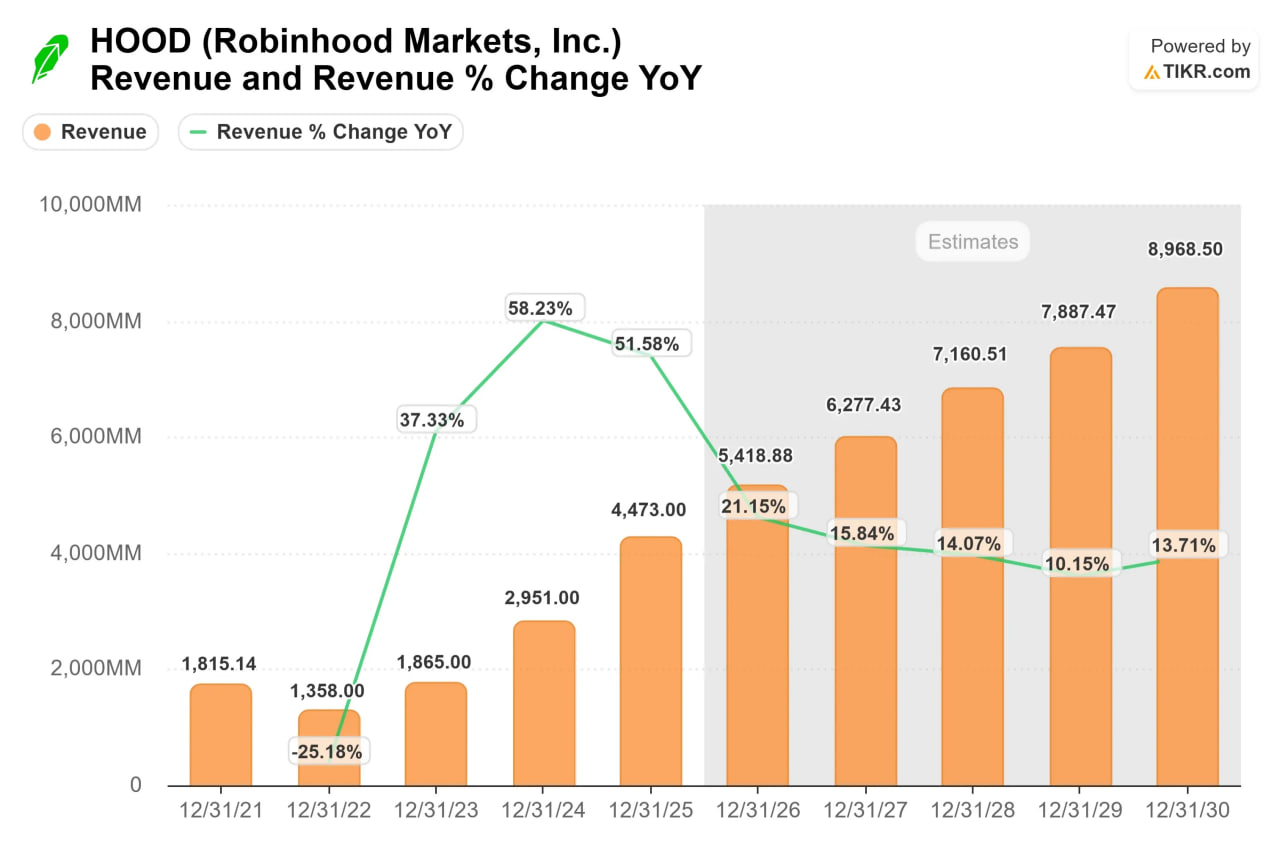
The most important figure is that nearly 92% of Robinhood's quarterly revenue came from non-crypto segments, including stocks, options, banking, credit cards, retirement, and prediction markets. All of these financial activities can potentially be brought onchain through Robinhood Chain.
2.3. What It Means for Hidden Gem Hunters?
Base succeeded because it had more than 120 million crypto users as its primary pipeline. Robinhood Chain has 29.9 million Investment Accounts, fewer in absolute number, but each account carries significantly greater financial power, based on Total Platform Assets of $369 billion, up 32% year over year. That works out to roughly $12,300 per account on average, while the user base also comes from multiple financial verticals rather than crypto alone.
When Stock Tokens such as NVDA, AAPL, and TSLA start being used as collateral in lending pools, when options traders move toward onchain perps instead of traditional brokerage platforms, and when banking depositors begin moving into yield-bearing stablecoins onchain, that is when Robinhood Chain could potentially explode in a way Base could not, because Base has only one primary source of users and liquidity: crypto.
In short, Base is backed by a crypto exchange. Robinhood Chain is backed by a diversified financial platform with $369 billion in Total Platform Assets, 29.9 million Investment Accounts, and asset growth of around 32% per year. The force behind Robinhood Chain is not only several times larger than Base in terms of financial assets, but also comes from a fundamentally different revenue structure.
3. Potential Projects Emerging on Robinhood Chain
The Robinhood versions of projects like Virtual and Aerodrome may not have appeared yet because the ecosystem has only been live for around two months, but several notable projects have already emerged.
Below are one to two leading projects in each major sector.
MEMECOIN
$CASHCAT is the leading memecoin on Robinhood Chain, inspired by Robinhood's original working name. Although it was not launched by Robinhood, the token has become one of the symbols of the chain and has been added by Robinhood for spot trading on the app and Robinhood Legend.
$HMM (Thinking Cat) is an early-stage memecoin associated with Wirebot, a tool that allows users to create and trade tokens through X. It represents the new wave of meme projects beginning to emerge on the chain.
DEX / PerpDEX
Uniswap has been the main liquidity layer since day one, supporting V2, V3, V4 and UniswapX. However, it is not a native dapp and has already been an established name in crypto for years.
$UP (UP33) is a native DEX built around the ve(3,3) model, aiming to become a liquidity hub for crypto and tokenized stocks. Its partnership with StonkBrokers positions UP as the liquidity engine for Stonk Exchange and Stonk Launcher.
Arcus is a trading platform built by a team with experience at dYdX and backed by a strategic investment from Robinhood Crypto. The platform supports more than 80 stock-token markets alongside perpetuals covering equities, commodities, indices, and crypto. It is still in the early access stage.
LAUNCHPAD
$PONS is a native launchpad that allows users to deploy new tokens and graduate successful tokens onto Uniswap with permanently locked liquidity. A large portion of protocol fees is used to buy back $PONS, creating direct value capture from platform activity.
NFT
StonkBrokers combines NFTs with financial products through ERC-6551, allowing each NFT to own its own wallet and interact with stock tokens. The ecosystem also includes an NFT AMM, lending products, and deep integration with UP33, creating a bridge between NFTs, RWA, and DeFi.
RWA
$INDEX turns trading activity into exposure to equities. The protocol uses part of its trading tax to automatically DCA into stock tokens such as NVDA, AAPL, and MSFT, then distributes equity exposure to holders. This is a particularly interesting use case because it converts crypto activity into exposure to traditional financial assets.
DEFI/LENDING
Morpho is the core lending infrastructure on Robinhood Chain and sits behind Robinhood Earn. If tokenized stocks become increasingly used as collateral,
$MORPHO could become the direct connection between tokenized equities and DeFi.
Conclusion
Robinhood Chain is currently at exactly the stage that makes it most interesting for Hidden Gem hunters: the infrastructure has just launched, institutional and retail capital are flowing in at the same time, yet the number of high-quality projects remains small compared with the amount of attention the chain is receiving.
The distribution advantage of nearly 30 million Robinhood accounts, combined with a much more diversified revenue structure than Coinbase, is what makes this thesis different from previous Layer 2 ecosystems.
If Robinhood continues bringing more users, assets, and financial products onchain, the protocols that emerge early could become critical infrastructure for the ecosystem. This is precisely the stage worth watching closely and searching for projects with the potential to become the next major winners, just as the Base and Coinbase ecosystem did before.
Disclaimer: This content does not constitute investment, tax, legal, financial, or accounting advice. MEXC Blog provides this information for educational purposes only. Always do your own research, understand the risks, and invest responsibly.