Gold Price Falls Near $4,000 After US-Iran Strikes Renew Inflation Fears
TLDR
- Gold dropped over 1% Monday, falling near $4,000 an ounce after fresh US-Iran strikes in the Persian Gulf
- Both sides have agreed to halt attacks and meet in Doha on Tuesday
- Gold is down roughly 23% since US and Israel launched strikes on Iran in late February
- Markets are pricing in a 30%+ chance the Fed raises interest rates by end of 2026
- Key economic data this week, including US jobs numbers, could influence the Fed’s next move
Fresh US-Iran military exchanges over the weekend sent gold lower on Monday, pushing the precious metal near the $4,000 level as inflation fears returned to the market.
Spot gold fell 1.1% to $4,043.62 an ounce in early Asian trade. Gold futures dropped 1% to $4,056.77.
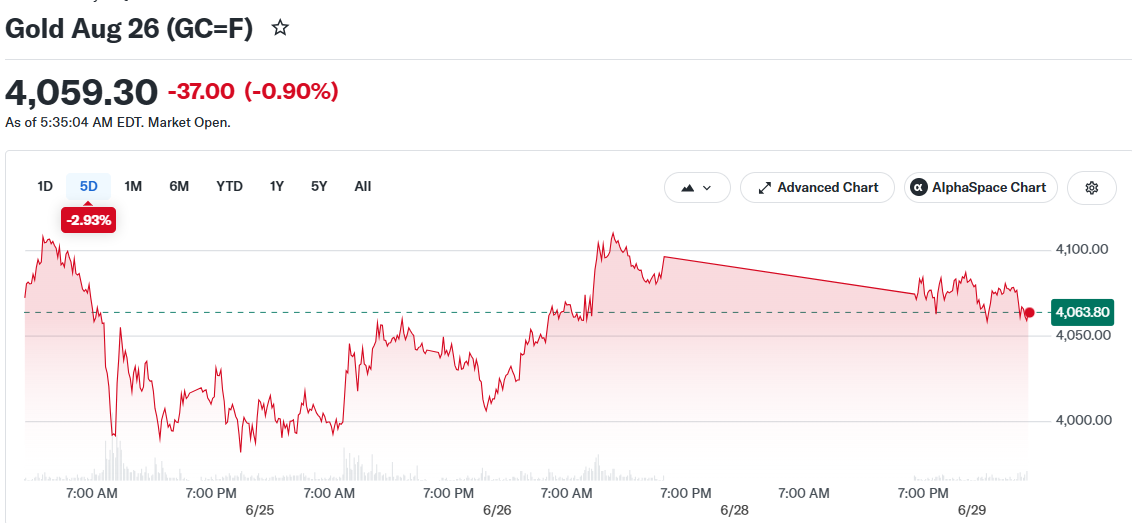 Gold Aug 26 (GC=F)
The US and Iran traded strikes in the Persian Gulf over the weekend, hitting a ceasefire that had helped calm energy markets in recent days. A tanker carrying Qatari crude was struck during the exchanges, disrupting shipping through the Strait of Hormuz.
Despite the renewed tension, both sides agreed to stop the attacks. They are set to meet in Doha on Tuesday, according to Axios, citing unnamed US officials.
Gold Under Pressure From Rates and a Strong Dollar
Gold has been sliding for months. It is down around 23% since the US and Israel launched strikes on Iran in late February.
Higher energy prices from the conflict pushed inflation up, which raised expectations that central banks would keep interest rates elevated for longer. That has weighed heavily on gold, which does not pay any yield.
Markets are now pricing in a more than 30% chance the Federal Reserve will raise rates by the end of 2026, according to CME Fedwatch data.
A strong US dollar and high Treasury yields have added further pressure. The Fed’s June meeting sent a hawkish signal, and recent US inflation data came in high, though within analyst estimates.
The Fed’s preferred inflation gauge, the personal consumption expenditures price index, rose 0.4% in May. Treasury yields dipped slightly after that reading.
Other precious metals also fell Monday. Silver dropped 1.8% to $58.11 an ounce. Platinum fell 0.4% to $1,612.20.
Jobs Data Could Be the Week’s Biggest Market Mover
Investors are watching a range of economic data this week for clues on where rates are headed.
Japanese industrial production, Chinese purchasing managers index figures, and European inflation numbers are all due out.
But the main event is the US nonfarm payrolls report for June. Labor market strength would give the Fed more room to raise rates.
Any signs that hiring remains strong could push gold lower still, as higher rates increase the cost of holding non-yielding assets like bullion.
The ceasefire talks in Doha on Tuesday will also be closely watched. A lasting peace deal could ease energy price pressures and reduce inflation expectations, which would shift the outlook for gold.
For now, the metal remains stuck near multi-month lows, caught between geopolitical uncertainty and the prospect of higher borrowing costs.
The post Gold Price Falls Near $4,000 After US-Iran Strikes Renew Inflation Fears appeared first on CoinCentral.


You May Also Like

Bitcoin Faces Volatile Week As Geopolitical Risks And Fed Signals Keep Traders On Edge: QCP Capital

AI spending boom accelerates as Big Tech pours trillions into infrastructure