Coinbase’s Base layer-2 network suffered two block production outages last week, and the project’s engineering team has traced both issues to problems in its sequencerCoinbase’s Base layer-2 network suffered two block production outages last week, and the project’s engineering team has traced both issues to problems in its sequencer

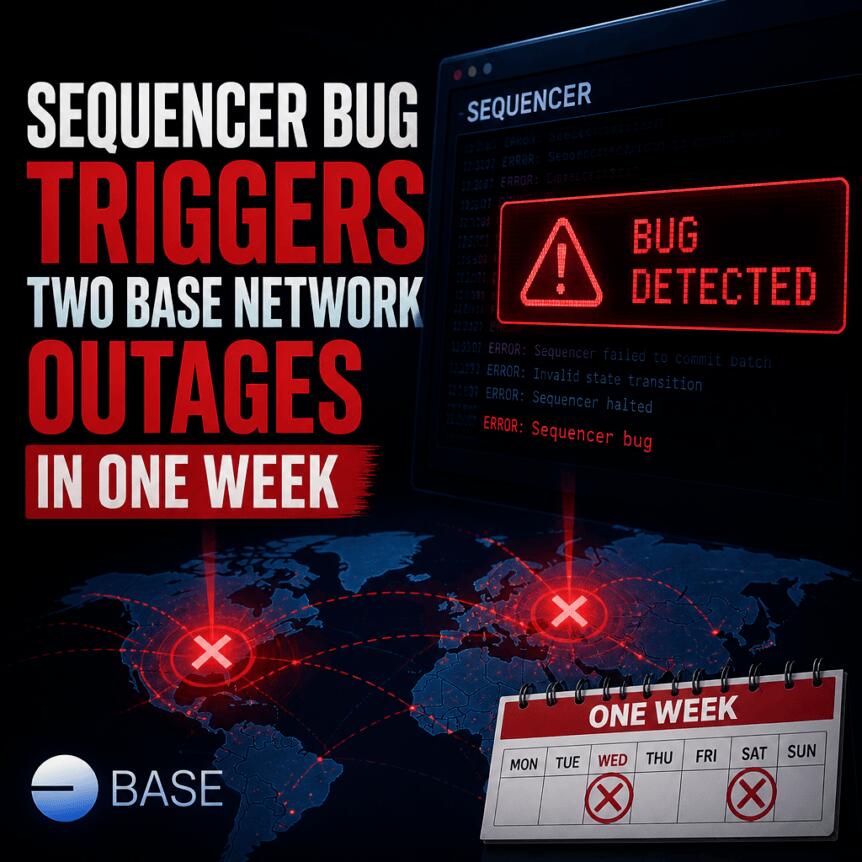
Sequencer Bug Triggers Two Base Network Outages in One Week
For feedback or concerns regarding this content, please contact us at crypto.news@mexc.com
Sequencer Bug Triggers Two Base Network Outages In One Week

Coinbase’s Base layer-2 network suffered two block production outages last week, and the project’s engineering team has traced both issues to problems in its sequencer infrastructure. According to a Saturday post-mortem, a bug in the block-building process caused “stale journal state” to remain after an execution failure—preventing the network from progressing until operators applied fixes.

Because Base runs with a single sequencer, the incident underscores a structural risk familiar to many rollups: when sequencer logic fails, block ordering and forward progress can stall across the whole chain. Base experienced a first outage on Thursday lasting 116 minutes, followed by a second that lasted 20 minutes, with a complete halt of new layer-2 block production during both events.

Key takeaways

  • Base’s engineering team linked the outages to sequencer block-building logic that left “stale journal state” after a transaction validation failure.
  • Base operates a single sequencer, so a sequencer-level defect can halt the entire network’s block production.
  • The second outage was worsened by a “race condition” after a system reset that prevented sequencers from catching up.
  • Engineers say remediation took longer than expected due to infrastructure conditions, not the original bug.
  • Planned follow-ups include more protocol “fuzz testing” and “graceful recovery” measures to reduce manual restarts.

What the post-mortem says went wrong

In the post-mortem, the Base engineering team explained that an invalid transaction reached the block builder and failed during execution—consistent with expected behavior. The failure, however, was followed by an unintended state-management outcome: the sequencer did not clear the journal state that records which accounts and storage slots were accessed during processing.

That journal state is critical to correct execution bookkeeping. If it persists when it should be cleared, later stages of block building can be forced into an inconsistent pathway, preventing the sequencer and validator nodes from moving past the problematic block. In this case, that’s what ultimately stopped progress on Base’s chain.

The post-mortem also points out why this is particularly disruptive on Base: the network uses a single sequencer. Unlike architectures that distribute sequencer responsibilities across multiple components, a single sequencer becomes a single point of failure for block production. The team’s analysis places the incident squarely in the sequencer layer, rather than the broader execution environment.

Two outages, one root process—and a second failure mode

Base mainnet halted block production twice over the Thursday–Friday window. The first incident lasted 116 minutes, while the second ran for 20 minutes. During both events, new layer-2 blocks stopped being produced, and the sequencer and validator nodes could not progress past the invalid block until sequencing was restored.

Engineers said they resolved the outages by patching the sequencers to ensure the journal state is properly updated during execution. However, they emphasized that the time required for mitigation exceeded expectations. The team attributed the delay to “infrastructure conditions unrelated to the original bug,” implying the remediation itself was more operationally complex than the underlying code fix.

Beyond the initial state-clearing issue, the post-mortem describes an additional complication after system reset: a “race condition” prevented the sequencers from catching up. This race condition, following the restart, is presented as the driver behind the second outage—meaning the chain did not simply fail once and recover, but experienced a follow-on stall tied to how components re-synchronized.

Why sequencer fragility matters to rollup users

While outages are never ideal, sequencer incidents carry a special weight for users because ordering is foundational to how rollups coordinate transactions. A centralized sequencer decides the order of transactions and packages them into blocks. When its block-building logic or recovery flow breaks, users can see cascading effects: delayed confirmations, stalled finality progress, and operational interruptions that can be difficult for end users to predict.

The Base team’s findings also resonate with a broader pattern across the rollup ecosystem. The post-mortem narrative aligns with earlier reporting that sequencer or sequencer-adjacent failures have triggered outages on other layer-2 networks as well, including Arbitrum, OP Mainnet, and zkSync Era. Those precedents help explain why developers and investors pay close attention to sequencer fault tolerance, restart behavior, and how systems handle invalid transactions under real-world conditions.

For Base specifically, the incident is likely to intensify scrutiny around resiliency and recovery mechanisms, given its “single sequencer” setup. In a centralized sequencer design, even small logical errors can have system-wide consequences if recovery pathways require manual intervention or are sensitive to timing.

What Base plans to do next

After identifying the immediate cause and applying patches, Base’s engineering team outlined improvements intended to reduce the likelihood of recurrence. Two steps are highlighted in the post-mortem: enhanced protocol “fuzz testing” and better “graceful recovery.”

Fuzz testing generally involves bombarding the system with large volumes of randomized inputs—including malformed or unexpected cases—to uncover edge-case failures that may not appear in standard testing. In this context, the goal is to better stress sequencer logic such that state-handling bugs—like improper journal state clearing—are caught earlier.

“Graceful recovery,” as described by the team, aims to ensure validator nodes don’t need manual restarts during future incidents. That matters because recovery time affects user experience and operational risk: the faster and more automatic the system can re-stabilize, the less time the network spends in a stalled state.

Base isn’t new to sequencer incidents

This isn’t Base’s first sequencer-related interruption. The post-mortem notes an earlier episode in September 2024 where block production stopped for 17 minutes, and another incident in August 2025 lasting around half an hour.

The network’s scale also makes these events more consequential. According to L2beat, Base is the second-largest layer-2 network by total value secured, just under $11 billion. With that level of capital and activity, sequencer reliability becomes more than a technical metric—it directly influences the perceived operational maturity of the chain.

As Base continues to grow, the industry will likely watch whether the promised improvements translate into faster, smoother recovery and fewer extended stalls. Even if the sequencer remains centralized, the fault-tolerance of its software pathways—especially around state management and reset behavior—can make a meaningful difference in how often outages cascade.

For now, Base users and builders should focus on how quickly engineering can validate the patched behavior under stress, and whether the planned fuzz testing and recovery upgrades reduce the chance of repeat failures—particularly those tied to invalid transaction handling and post-reset synchronization.

This article was originally published as Sequencer Bug Triggers Two Base Network Outages in One Week on Crypto Breaking News – your trusted source for crypto news, Bitcoin news, and blockchain updates.

Market Opportunity
Solayer Logo
Solayer Price(LAYER)
$0.06593
$0.06593$0.06593
-3.58%
USD
Solayer (LAYER) Live Price Chart
Disclaimer: The articles reposted on this site are sourced from public platforms and are provided for informational purposes only. They do not necessarily reflect the views of MEXC. All rights remain with the original authors. If you believe any content infringes on third-party rights, please contact crypto.news@mexc.com for removal. MEXC makes no guarantees regarding the accuracy, completeness, or timeliness of the content and is not responsible for any actions taken based on the information provided. The content does not constitute financial, legal, or other professional advice, nor should it be considered a recommendation or endorsement by MEXC.

You May Also Like

Ethereum koers toont zeldzaam dubbel koopsignaal en richt zich op $4.550

Ethereum koers toont zeldzaam dubbel koopsignaal en richt zich op $4.550

Connect met Like-minded Crypto Enthusiasts! Connect op Discord! Check onze Discord   Ethereum laat op de uurgrafiek twee opeenvolgende TD Sequential koopsignalen zien. Deze indicator meet uitputting in een trend en geeft vaak een signaal dat de verkoopdruk kan afnemen. Dit dubbele signaal verschijnt rond het niveau van $4.516, waar de ETH prijs kortstondig steun vindt. Dit type formatie komt zelden voor en wordt daarom extra nauwlettend gevolgd. Wat gaat de Ethereum koers hiermee doen? Ethereum koers test steun rond $4.516 De scherpe daling van de Ethereum koers vanaf de prijszone rond $4.800 bracht de ETH prijs in korte tijd naar ongeveer $4.516. Op dit niveau trad duidelijke koopactiviteit op, waardoor de neerwaartse beweging tijdelijk werd gestopt. Het dubbele signaal dat door de TD Sequential indicator is gegenereerd, viel precies samen met dit prijspunt. De TD Sequential is opgebouwd uit negen candles die een trend meetellen. Wanneer de negende candle verschijnt, kan dit duiden op een trendomslag. In dit geval verschenen zelfs twee signalen kort na elkaar, wat aangeeft dat de verkoopdruk mogelijk uitgeput is. Het feit dat dit gebeurde in een zone waar ETH kopers actief bleven, maakt het patroon extra opvallend. TD Sequential just flashed two buy signals for Ethereum $ETH! pic.twitter.com/JPO8EhiEPi — Ali (@ali_charts) September 16, 2025 Welke crypto nu kopen?Lees onze uitgebreide gids en leer welke crypto nu kopen verstandig kan zijn! Welke crypto nu kopen? Fed-voorzitter Jerome Powell heeft aangekondigd dat de rentes binnenkort zomaar eens omlaag zouden kunnen gaan, en tegelijkertijd blijft BlackRock volop crypto kopen, en dus lijkt de markt klaar om te gaan stijgen. Eén vraag komt telkens terug: welke crypto moet je nu kopen? In dit artikel bespreken we de munten die… Continue reading Ethereum koers toont zeldzaam dubbel koopsignaal en richt zich op $4.550 document.addEventListener('DOMContentLoaded', function() { var screenWidth = window.innerWidth; var excerpts = document.querySelectorAll('.lees-ook-description'); excerpts.forEach(function(description) { var excerpt = description.getAttribute('data-description'); var wordLimit = screenWidth wordLimit) { var trimmedDescription = excerpt.split(' ').slice(0, wordLimit).join(' ') + '...'; description.textContent = trimmedDescription; } }); }); Technische indicatoren schetsen herstelkans voor ETH Naast de dubbele koopsignalen verstrekken ook andere indicatoren belangrijke aanwijzingen. Tijdens de daling van de ETH koers waren grote rode candles zichtbaar, maar na de test van $4.516 stabiliseerde de Ethereum koers. Dit wijst op een mogelijke verschuiving in het evenwicht tussen de bears en bulls. Als deze opwaartse beweging doorzet, liggen de eerste weerstanden rond $4.550. Daarboven wacht een sterkere zone rond $4.650. Deze niveaus zijn in eerdere Ethereum sessies al meerdere keren getest. Een doorbraak zou ruimte openen richting de all-time high van ETH rond $4.953. Wanneer de prijs toch opnieuw onder $4.516 zakt, liggen er zones rond $4.500 en $4.450 waar grotere kooporders worden verwacht. Deze niveaus kunnen als een vangnet fungeren, mocht de druk opnieuw toenemen. Marktdynamiek bevestigt technische indicatoren De huidige situatie volgt op een bredere correctie in de cryptomarkt. Verschillende vooraanstaande crypto tokens zagen scherpe koersdalingen, waarna traders op zoek gingen naar signalen voor een mogelijke ommekeer. Dat juist Ethereum nu een dubbel TD Sequential signaal toont, versterkt de interesse in dit scenario. Fundamenteel blijft Ethereum sterk. Het aantal ETH tokens dat via staking is vastgezet, blijft groeien. Dat verkleint de vrije circulatie en vermindert verkoopdruk. Tegelijk blijft het netwerk intensief gebruikt voor DeFi, NFT’s en stablecoins. Deze activiteiten zorgen voor een stabiele vraag naar ETH, ook wanneer de prijs tijdelijk onder druk staat. Fundamentele drijfveren achter de Ethereum koers De Ethereum koers wordt echter niet alleen bepaald door candles en patronen, maar ook door bredere factoren. Een stijgend percentage van de totale ETH supply staat vast in staking contracten. Hierdoor neemt de liquiditeit op exchanges af. Dit kan prijsschommelingen versterken wanneer er plotseling meer koopdruk ontstaat. Daarnaast is Ethereum nog steeds het grootste smart contract platform. Nieuwe standaarden zoals ERC-8004 en ontwikkelingen rond layer-2 oplossingen houden de activiteit hoog. Deze technologische vooruitgang kan de waardepropositie ondersteunen en zo indirect bijdragen aan een ETH prijsherstel. Het belang van de korte termijn dynamiek De komende handelsdagen zullen duidelijk maken of de bulls genoeg kracht hebben om door de weerstandszone rond $4.550 te breken. Voor de bears ligt de focus juist op het verdedigen van de prijsregio rond $4.516. De whales, die met grote handelsorders opereren, kunnen hierin een beslissende rol spelen. Het dubbele TD Sequential signaal blijft hoe dan ook een zeldzame gebeurtenis. Voor cryptoanalisten vormt het een objectief aanknopingspunt om de kracht van de huidige Ethereum trend te toetsen. Vooruitblik op de ETH koers Ethereum liet twee opeenvolgende TD Sequential signalen zien op de uurgrafiek, iets wat zelden voorkomt. Deze formatie viel samen met steun rond $4.516, waar de bulls actief werden. Als de Ethereum koers boven dit niveau blijft, kan er ruimte ontstaan richting $4.550 en mogelijk $4.650. Zakt de prijs toch opnieuw onder $4.516, dan komen $4.500 en $4.450 in beeld als nieuwe steunzones. De combinatie van zeldzame indicatoren en een sterke fundamentele basis maakt Ethereum interessant voor zowel technische als fundamentele analyses. Of de bulls het momentum echt kunnen overnemen, zal blijken zodra de Ethereum koers de eerstvolgende weerstanden opnieuw test. Koop je crypto via Best Wallet Best wallet is een topklasse crypto wallet waarmee je anoniem crypto kan kopen. Met meer dan 60 chains gesupport kan je al je main crypto coins aanschaffen via Best Wallet. Best wallet - betrouwbare en anonieme wallet Best wallet - betrouwbare en anonieme wallet Meer dan 60 chains beschikbaar voor alle crypto Vroege toegang tot nieuwe projecten Hoge staking belongingen Lage transactiekosten Best wallet review Koop nu via Best Wallet Let op: cryptocurrency is een zeer volatiele en ongereguleerde investering. Doe je eigen onderzoek. Het bericht Ethereum koers toont zeldzaam dubbel koopsignaal en richt zich op $4.550 is geschreven door Dirk van Haaster en verscheen als eerst op Bitcoinmagazine.nl.
Share
Coinstats2025/09/17 23:31
Fed Day Dry Powder: Cryptoquant Analyst Tracks $7.6B Stablecoin Pile on Exchanges

Fed Day Dry Powder: Cryptoquant Analyst Tracks $7.6B Stablecoin Pile on Exchanges

The post Fed Day Dry Powder: Cryptoquant Analyst Tracks $7.6B Stablecoin Pile on Exchanges appeared on BitcoinEthereumNews.com. With the Federal Reserve meeting today, onchain flows are telegraphing that crypto traders are topping off exchanges and leaning long ahead of a widely expected 25-basis-point cut. Pre-Fed Positioning Stablecoins are doing the heavy lifting. Cryptoquant data shows $7.6 billion in fresh USDT and USDC (ERC-20) deposits heading to trading venues ahead of the decision. […] Source: https://news.bitcoin.com/fed-day-dry-powder-cryptoquant-analyst-tracks-7-6b-stablecoin-pile-on-exchanges/
Share
BitcoinEthereumNews2025/09/18 01:36
Michael Saylor’s Bitcoin Treasury Strategy Has Finally Hit Its Breaking Point

Michael Saylor’s Bitcoin Treasury Strategy Has Finally Hit Its Breaking Point

Bitcoin (CRYPTO:BTC) transformed from a niche digital asset into a mainstream investment over the past decade, and few people did more to accelerate that shift
Share
247 Wall St.2026/06/28 20:17

Newbies:Deposit $100, Get $1,000

Newbies:Deposit $100, Get $1,000Newbies:Deposit $100, Get $1,000

Plus Up to a $50 Referral Bonus