Garlinghouse Bitcoin View: Bullish on BTC, Bearish on Saylor

Brad Garlinghouse has a clear message: he still believes in bitcoin, but he thinks Michael Saylor’s method of buying it has done more harm than good. Speaking in a CNBC interview, the Ripple CEO drew a sharp line between the asset and the financial architecture built around it — a distinction that matters more than ever as that architecture starts showing cracks.
Key takeaways
- Ripple CEO Brad Garlinghouse’s bitcoin view remains bullish, but he sharply criticizes Strategy’s preferred-share funding model as harmful to the broader crypto market.
- STRC preferred shares, engineered to trade near $100 with an 11.5% annual dividend, recently fell to a record low roughly 25% below that target price.
- Strategy’s common stock dropped to its lowest level since February 2024, with bitcoin itself falling below $59,000 during the same period.
- CryptoQuant recommends Strategy pause bitcoin purchases, noting dividend coverage has thinned from over seven years to about 14 months.
- Benchmark-StoneX analyst Mark Palmer describes the funding engine as “less efficient” rather than broken, rejecting comparisons to assets that have collapsed outright.
Garlinghouse’s Bullish Bitcoin View — With a Major Caveat
“Financial engineering does not drive long-term value,” Garlinghouse said plainly. His argument is that the lasting worth of any digital asset flows from its usefulness — not from the complexity of the financial structures layered on top of it.
That critique landed directly on Michael Saylor and the machine he built at Strategy. “Team Michael Saylor wasn’t focused on the right stuff and that has hurt the overall market,” Garlinghouse said. The Ripple CEO was careful to separate the critique from the asset itself — he was quick to note he remains bullish on bitcoin as a long-term proposition. The problem, in his telling, is the execution.
This distinction matters for the broader crypto market. When a prominent figure from a competing corner of the industry says the most aggressive institutional bitcoin buyer has been a distraction rather than a catalyst, it signals something beyond a boardroom rivalry. It’s a question about whether financial engineering around bitcoin accumulation actually strengthens crypto’s foundations or quietly erodes them.
How Strategy’s Preferred-Share Funding Model Works
Strategy’s approach is straightforward in structure, if unusual in practice. For roughly a year, the company has raised cash by issuing preferred shares — a class of stock that pays a fixed dividend — and then used those proceeds to buy more bitcoin.
The centerpiece of this mechanism is the STRC preferred share, which carries an 11.5% annual dividend and is designed to trade near $100. The logic is clean when conditions cooperate: issue shares near par, collect capital, deploy it into bitcoin, and repeat. The dividend yield attracts income-oriented investors, while bitcoin appreciation theoretically makes the whole system self-sustaining.
When STRC trades near or above $100, the engine runs efficiently. When it falls below that level, the ability to issue new shares and buy more bitcoin slows dramatically — or stops altogether.
Market Pressure on Strategy and STRC
STRC hits a record low
Right now, the engine is stalling. STRC hit a record low on Thursday, falling as much as 26% below par, and was recently trading about 25% below the $100 target. Garlinghouse called that gap a “damning indictment” of the strategy — and given the mechanics of the model, it’s hard to argue the characterization is purely rhetorical.
When STRC trades below $100, Strategy effectively can’t issue new shares at favorable terms. Share issuance stops. Bitcoin buying pauses. The flywheel stalls. That’s precisely what has happened.
Strategy’s common stock and bitcoin’s slide
The pressure hasn’t been limited to the preferred shares. Strategy’s common stock dropped to its lowest since February 2024, closing around $82 on Friday. Bitcoin itself fell below $59,000 during the same stretch — a reminder that the model’s stress is not happening in a vacuum. Lower bitcoin prices reduce the implied value of Strategy’s holdings, which in turn weakens confidence in the preferred shares backed by that treasury, creating a feedback loop that analysts are watching closely.
Reactions and Analyst Perspectives
CryptoQuant urges a pause
CryptoQuant published a report recommending that Strategy halt bitcoin purchases and rebuild its cash reserves. The firm’s concern is specific and measurable: the cushion supporting STRC’s dividend payments has thinned dramatically, shrinking from more than seven years of coverage to approximately 14 months. That’s a significant compression of the safety buffer that underpins investor confidence in the preferred shares.
Benchmark-StoneX pushes back on the doom narrative
Not everyone views the situation as a structural failure. Benchmark-StoneX analyst Mark Palmer argued that Strategy’s funding engine has become “less efficient” rather than broken — and explicitly rejected comparisons between STRC and assets that have collapsed entirely. It’s a meaningful distinction. Reduced efficiency is a mechanical problem with potential remedies; a broken model implies something more fundamental.
The analytical disagreement between CryptoQuant and Palmer captures the real uncertainty in the market. The preferred-share funding model is under genuine stress, and the divergence in expert interpretation reflects the fact that nobody has seen this exact structure tested under these exact conditions before. Whether Strategy uses the pause to rebuild financial headroom — as CryptoQuant suggests — or simply waits for bitcoin and STRC prices to recover, will likely define how the model is judged over the next year.
FAQ
What is Brad Garlinghouse’s view on bitcoin?
Brad Garlinghouse remains bullish on bitcoin and believes its long-term value comes from its usefulness, not from financial engineering built around it.
How does Michael Saylor’s preferred-share funding model work?
Strategy issues preferred shares — specifically STRC shares — that pay a fixed 11.5% annual dividend and are designed to trade near $100. The proceeds from issuing those shares are used to buy bitcoin.
Why have Strategy’s STRC preferred shares declined recently?
STRC shares traded about 25% below the $100 target, hitting a record low, reflecting growing market concerns about the sustainability of the funding model amid thinning dividend coverage and falling bitcoin prices.
What are the recommendations regarding Strategy’s bitcoin purchases?
CryptoQuant recommends that Strategy pause bitcoin buying and rebuild cash reserves, citing a dramatic reduction in dividend coverage from over seven years down to roughly 14 months. Benchmark-StoneX analyst Mark Palmer takes a less dire view, describing the model as less efficient rather than fundamentally impaired.
Article produced with the assistance of artificial intelligence and reviewed by the editorial team.
You May Also Like
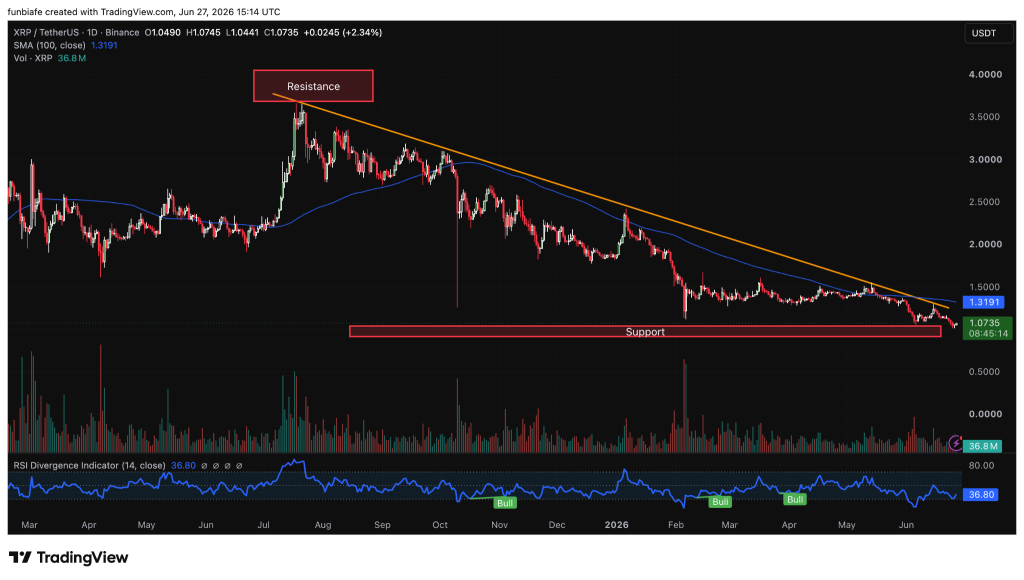
What Happens to the XRP Price if the Crypto Bear Market Gets Worse?

Solana SOL Reclaims $72, But Fading On-Chain Metrics Signal Weakening DEX Momentum

Bitcoin Price Prediction: Analysts Believe BTC Bottom Window Is Open