

FIFA World Cup 2026 Prize Money: How Much Will the Champions Earn?
The FIFA World Cup 2026 will be the most lucrative tournament in football history, featuring an estimated prize pool of approximately $850 million distributed among 48 participating nations. Hosted by Canada, Mexico, and the United States from June 11 to July 19, 2026, the expanded tournament not only introduces a new 48-team format but also significantly increases financial rewards for national federations. This guide explains how World Cup prize money is distributed, how much each stage is worth, and what the expanded financial structure means for participating teams.
FIFA World Cup 2026 Total Prize Pool
FIFA is expected to allocate around $850 million in prize money for the 2026 World Cup, nearly doubling the $440 million distributed during the 2022 FIFA World Cup in Qatar. The increase reflects:
- Expansion from 32 to 48 teams
- Growth from 64 to 104 matches
- Higher broadcasting revenues
- Increased sponsorship income
- Greater global audience engagement
Every qualified nation receives guaranteed financial support, while additional earnings depend on tournament performance.
FIFA World Cup 2026 Prize Money by Stage
The estimated prize distribution is outlined below:
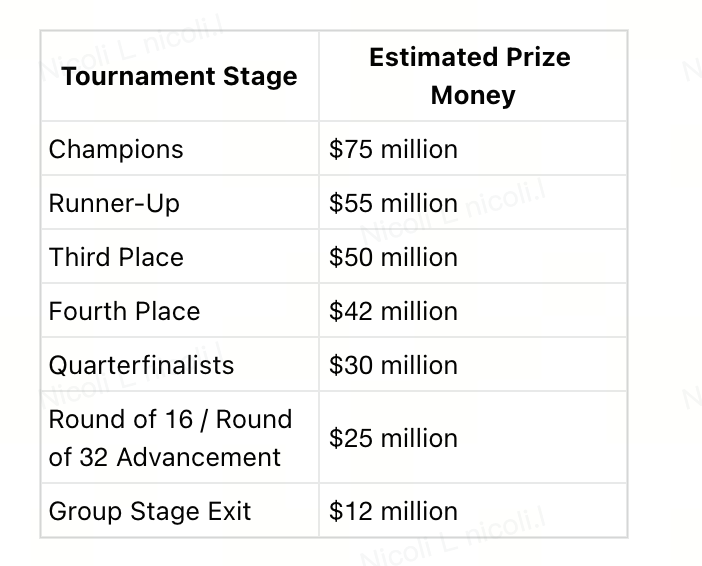
The expanded structure ensures that all participating nations receive substantial financial rewards regardless of results.
How Much Will the World Cup Champions Earn?
The 2026 World Cup winner is expected to receive approximately $75 million, making it the highest championship payout in tournament history. This reward reflects FIFA's growing commercial success and the increased number of matches required to win the tournament under the new format. Beyond the financial reward, winning the World Cup provides federations with significant resources to invest in:
- Youth development programs
- Training facilities
- Coaching education
- Women's football initiatives
- Grassroots football projects
The champion's earnings will exceed the entire annual budgets of many football federations worldwide.
Runner-Up and Third-Place Prize Money
The tournament runner-up is projected to receive approximately $55 million. While falling short in the final, the second-place team still secures one of the largest payouts in international football. The third-place team is expected to earn around $50 million, while the fourth-place finisher receives approximately $42 million. The relatively small gap between these positions reflects FIFA's effort to reward deep tournament runs rather than concentrating all financial benefits on the champion.
Quarterfinal and Knockout Stage Rewards
Teams reaching the quarterfinals are expected to earn approximately $30 million each. Meanwhile, nations advancing into the knockout rounds but failing to reach the quarterfinal stage can earn around $25 million. These rewards provide significant incentives for teams to progress beyond the group stage and ensure that successful tournament campaigns generate meaningful financial returns. For many federations, reaching the knockout rounds can fund development projects for several years.
Group Stage Participation Payments
Even teams eliminated during the group stage receive approximately $12 million. This guaranteed payment ensures that every nation benefits financially from qualification. In addition, FIFA provides preparation funding before the tournament to help national teams cover costs associated with:
- Training camps
- Travel logistics
- Friendly matches
- Accommodation
- Medical and performance staff
As a result, participation alone can transform the financial outlook of smaller football federations.
Comparison With Previous World Cups
The 2026 World Cup represents the largest prize-money increase in tournament history.
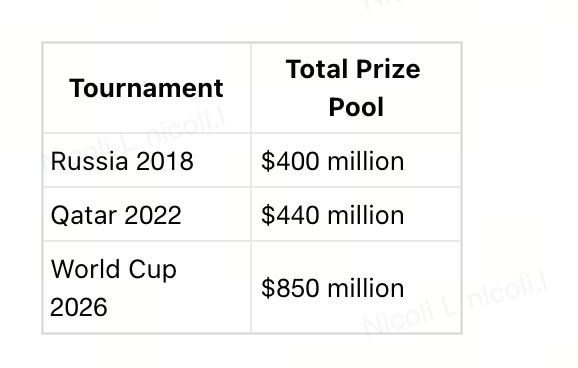
TournamentTotal Prize Pool
Russia 2018$400 millionQatar 2022$440 millionWorld Cup 2026$850 million Champion rewards have also grown substantially:
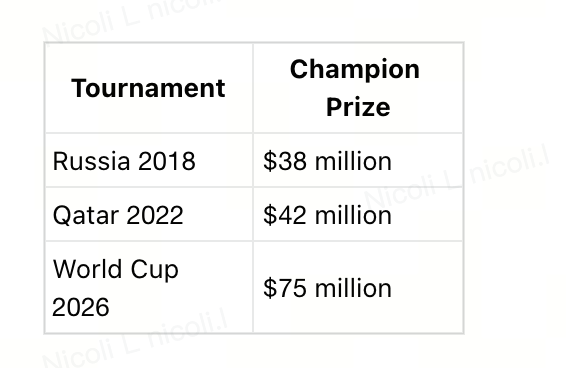
TournamentChampion Prize
Russia 2018$38 millionQatar 2022$42 millionWorld Cup 2026$75 million The increase demonstrates football's growing commercial value and FIFA's commitment to distributing more revenue to participating nations. Economic Impact on National Teams For emerging football nations, World Cup prize money can be transformational. Previous participants have used tournament earnings to:
- Build national training centers
- Expand youth academies
- Improve scouting networks
- Develop women's football programs
- Upgrade federation infrastructure
For smaller federations, a single World Cup appearance can generate more revenue than several years of normal operations. The expanded 48-team format means more countries will gain access to these financial benefits for the first time. Player Bonuses and Federation Distribution Prize money is paid directly to national football federations rather than individual players. Each federation determines how funds are distributed among:
- Players
- Coaching staff
- Support personnel
- Development programs
- Administrative operations
Many teams negotiate performance-based bonus agreements before the tournament begins. As a result, players from successful teams can earn substantial bonuses in addition to their club salaries. Why FIFA Increased the Prize Pool The larger prize pool is funded by record-breaking commercial revenues generated through:
- Global broadcasting rights
- Sponsorship agreements
- Advertising partnerships
- Matchday ticket sales
- Hospitality packages
- Licensing and merchandise sales
With 104 matches scheduled across North America, FIFA expects the 2026 World Cup to become the highest-grossing tournament in football history. World Cup Predictions and Fan Engagement The expanded format creates more matches, more storylines, and additional opportunities for fans to engage with the tournament. Sports prediction markets allow football fans to evaluate probabilities for:
- World Cup winners
- Group winners
- Qualification scenarios
- Individual match outcomes
The MEXC Global Football 2026 campaign features a prize pool of 1,360,000 USDT, allowing participants to engage with tournament predictions throughout the competition. Conclusion The FIFA World Cup 2026 will distribute approximately $850 million in prize money, making it the richest tournament in football history. Champions are expected to earn around $75 million, runners-up $55 million, and even teams eliminated during the group stage will receive roughly $12 million. The expanded 48-team format not only increases global participation but also delivers greater financial opportunities for football federations worldwide. From powerhouse nations chasing the championship to emerging teams making their World Cup debut, the 2026 tournament offers unprecedented sporting and economic rewards that will shape international football for years to come.


추천 콘텐츠

Tokenized RWA Markets Remained Resilient During US-Iran Conflict – Bitget-Block Scholes Report

Iran’s foreign minister targeted in assassination attempt, wife killed

Zimbabwe Crypto Regulation S.I. 99 of 2026 Takes Effect Now


인기 뉴스
더보기
