U.S. Dollar Hits Six-Week High as Iran War Fuels Rate Hike Fears
TLDR
- The U.S. dollar index rose to a six-week high of 99.47 on Wednesday, driven by rate hike speculation tied to Iran war inflation.
- Markets are now pricing in a more than 50% chance the Federal Reserve will raise interest rates by December.
- The 30-year U.S. Treasury yield hit its highest level since 2007, pushing bond markets into a deep selloff.
- The Japanese yen weakened back toward 160 per dollar, reviving fears of another round of Japanese government intervention.
- The Indian rupee fell to a record low of 96.784 per dollar, pressured by surging oil prices and India’s heavy reliance on energy imports.
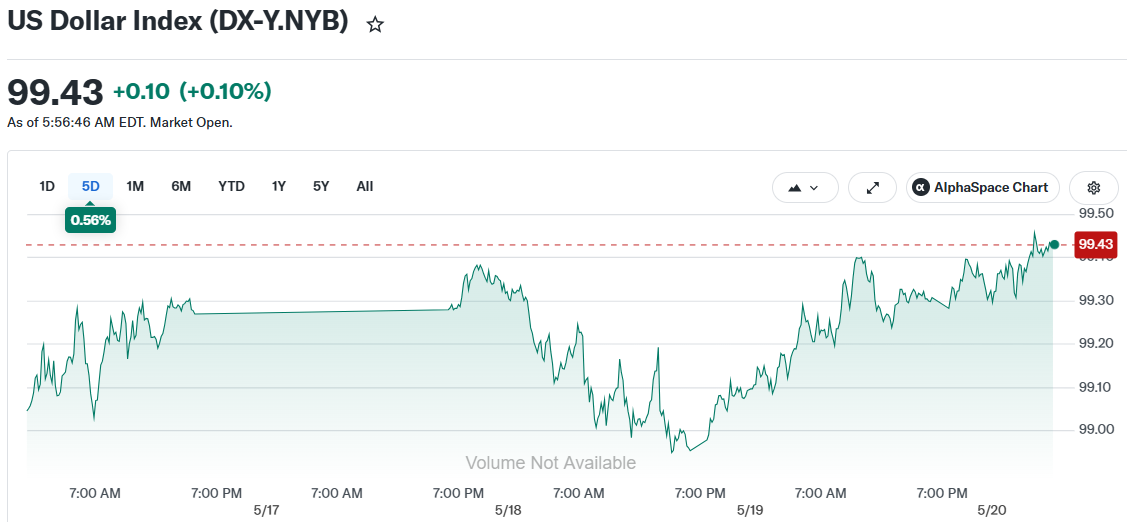
The U.S. dollar climbed to its highest point in six weeks on Wednesday as investors weighed the possibility of Federal Reserve interest rate hikes to fight inflation sparked by the ongoing Iran war.
The dollar index, which measures the greenback against six major currencies, rose 0.1% to 99.47. That’s its strongest level since April 7. The index is now up more than 1.3% in May alone.
 US Dollar Index (DX-Y.NYB)
Iran War Keeps Inflation Fears Alive
The conflict has blocked roughly a fifth of the world’s oil supply by effectively closing the Strait of Hormuz. Brent crude is trading around $110 per barrel, more than 50% higher than it was before the war began in late February.
That energy price surge has fed directly into inflation data, putting the Federal Reserve in a difficult position. Traders using CME FedWatch now see more than a 50% chance of a rate hike by December — a sharp reversal from expectations of two cuts earlier this year.
President Donald Trump said the U.S. may need to strike Iran again, but also hinted that Tehran is interested in a deal. Oil prices dipped slightly Wednesday after Washington said talks were progressing, but losses were limited.
Philadelphia Federal Reserve President Anna Paulson said on Tuesday that it was “healthy” for markets to speculate about rate hikes, adding that current monetary policy appeared appropriately restrictive.
The euro fell to a six-week low of $1.158, down 0.16%. The British pound slipped to $1.338, near its own six-week low. The Australian dollar was little changed at $0.711 after dropping 0.9% the day before.
Yen Slides Back Toward Danger Zone
The Japanese yen fell back near the 160-per-dollar level that triggered Japanese government intervention last month. Tokyo stepped in at the end of April and early May to slow the yen’s slide, but the effects did not last.
The yen was trading at 159.01 per dollar Wednesday. U.S. Treasury Secretary Scott Bessent signaled Washington wants the Bank of Japan to raise rates further, saying he was confident the BOJ governor would “do what he needs to do” if given sufficient independence.
Currency strategists warned that intervention may only slow dollar-yen’s move rather than reverse it, unless U.S. Treasury yields and the broader dollar weaken. The 30-year U.S. Treasury yield hit its highest level since 2007 this week, a key driver of dollar strength.
The Indian rupee hit a record low of 96.784 per dollar Wednesday. India’s heavy reliance on energy imports makes its currency especially vulnerable when oil prices spike. Traders also questioned how much the Reserve Bank of India could do to defend the rupee.
The Chinese yuan edged slightly lower against the dollar. Tensions between China and Taiwan also climbed after Trump raised questions about future U.S. arms sales to Taipei and warned against declaring independence. Taipei said it would welcome a direct call with the president.
The Federal Reserve is due to release minutes from its last meeting later Wednesday, which investors will watch closely for any signals on the rate path ahead.
The post U.S. Dollar Hits Six-Week High as Iran War Fuels Rate Hike Fears appeared first on CoinCentral.


You May Also Like

How Stablecoins Are Changing Business Payments

Lowe’s (LOW) Stock Falls After Earnings Beat Gets Overshadowed by Weak Guidance