

Does Someone Have to Pay Tax If They Only Hold Crypto and Never Sell in India?
BitcoinWorld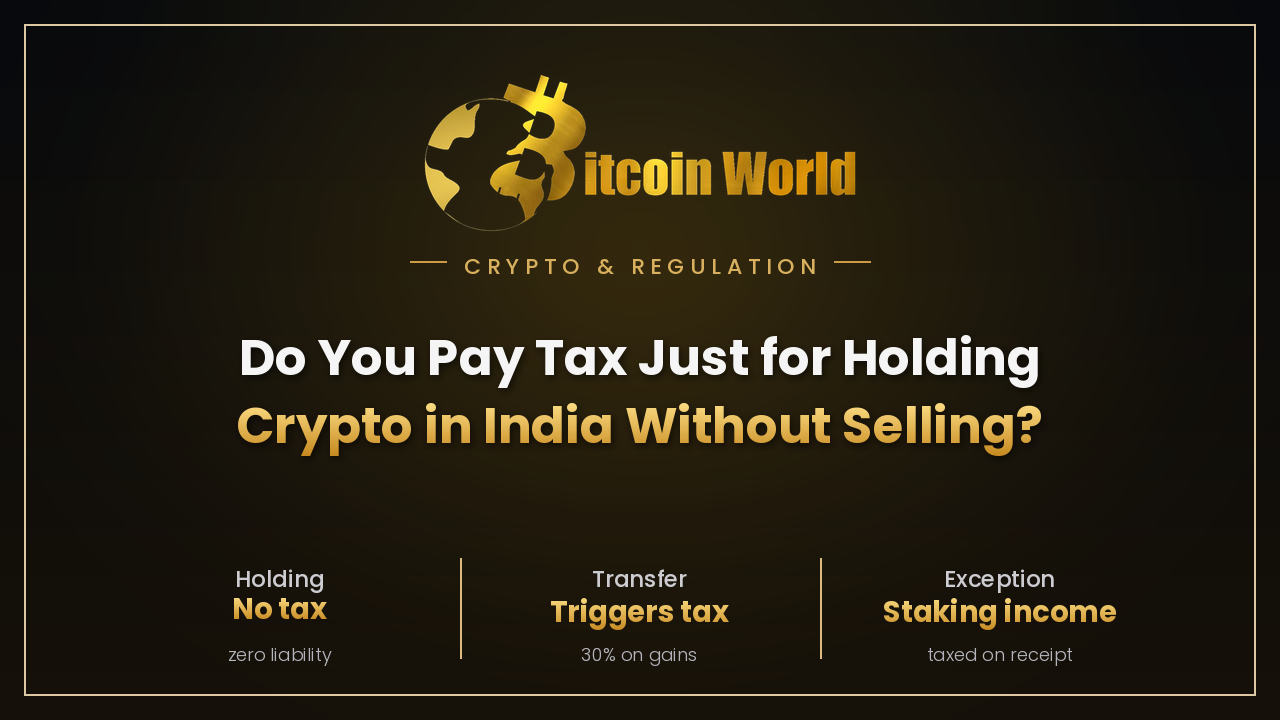
Does Someone Have to Pay Tax If They Only Hold Crypto and Never Sell in India?
Does Someone Have to Pay Tax If They Only Hold Crypto and Never Sell in India?
Whether someone has to pay tax just for holding crypto in India is one of the most googled crypto questions in the country – and the answer is clearly no, as long as the asset isn’t sold, transferred, swapped, or used. Tax in India’s crypto framework is triggered by a transfer, not by ownership alone. This article explains exactly what holding means under current Indian law, what events do trigger tax, and the one exception that catches many users by surprise. Information is accurate and reflects rules under India’s Income Tax Act 2025, current as of June 2026.
Does Someone Have to Pay Tax If They Only Hold Crypto and Never Sell in India?
No – simply holding crypto triggers no tax liability in India. Tax is triggered only when a transfer occurs.
- Holding = no tax event: Buying and keeping crypto – Bitcoin, ETH, USDT, or any VDA – incurs no tax for however long you hold it.
- Transfer triggers tax: The 30% flat tax under the Income Tax Act 2025 applies to income from the transfer of a Virtual Digital Asset (VDA).
- Any disposal counts: Selling for INR, swapping one crypto for another, spending crypto on goods, and gifting crypto above exemption limits all constitute taxable transfers.
- Time held is irrelevant: Unlike stocks, there is no short-term vs long-term distinction – the 30% rate applies regardless of how long the asset was held.
What Exactly Counts as a Taxable Transfer in India?
Several common actions that users might not think of as “selling” still trigger tax.
- Selling for INR: The clearest case – converting crypto to rupees on an exchange is a taxable transfer.
- Crypto-to-crypto swaps: Trading Bitcoin for Ethereum, or any coin for another, is a taxable transfer – even though no INR is involved.
- Spending crypto: Using crypto to pay for goods or services qualifies as a transfer under VDA rules.
- Gifting crypto: Gifts above the exemption threshold are taxable for the recipient; the transfer itself may also be a taxable event for the sender.
- Moving between your own wallets: Transferring between wallets you own is not considered a taxable transfer – but maintaining clear records showing both wallets belong to you is important.
What Is the Exception That Catches Many Users – Staking, Mining, and Airdrops?
Even without selling, some forms of crypto income are taxable when received.
- Staking rewards: Income from staking is taxed at your applicable income tax slab rate when received, as income from other sources.
- Mining income: Similarly taxed as income on receipt; subsequent sale of mined coins is taxed at 30%.
- Airdrops: Free token distributions are treated as income at their fair market value on receipt.
- The mechanism: The fair market value at the time of receipt becomes the cost of acquisition for any future sale.
What Else Do Indian Crypto Holders Need to Know?
Beyond the holding rule, several enforcement and reporting requirements affect all VDA holders.
- Schedule VDA in ITR: All holders who have transferred VDAs must disclose gains in Schedule VDA of their ITR (ITR-2 or ITR-3).
- Foreign assets disclosure: Indian residents holding crypto on foreign platforms (Binance Global, Coinbase, etc.) valued above ₹20 lakh must disclose in Schedule FA.
- 1% TDS: Exchanges deduct 1% TDS on qualifying transfers – this is advance tax, not the final tax liability.
- No loss offset: Losses from one crypto cannot be offset against gains from another, or from any other income source.
Frequently Asked Questions
Do you owe tax in India if you bought Bitcoin years ago and never sold it?
No – holding Bitcoin or any other VDA without transferring it creates no tax liability, regardless of how long you have held it or how much its value has increased on paper. Tax is triggered only when you sell, swap, spend, or otherwise transfer the asset. Unrealised gains sitting in your wallet are not taxable under India’s current VDA framework.
Is swapping one cryptocurrency for another taxable in India?
Yes – exchanging one cryptocurrency for another, even without converting to rupees, is treated as a transfer of a VDA and triggers the 30% tax on any gain. The gain is calculated as the fair market value of the crypto received minus your cost of acquisition for the crypto given up. This is one of the most important and frequently misunderstood rules in India’s crypto tax framework.
Do you have to declare crypto holdings in your income tax return even if you didn’t sell anything?
If you haven’t made any transfers during the financial year, there is generally no VDA income to declare in Schedule VDA. However, if you received staking rewards, airdrops, or mining income – or hold crypto on foreign platforms above the ₹20 lakh threshold – disclosure obligations still apply. As enforcement and reporting requirements tighten under the Income Tax Act 2025, maintaining clear transaction records is advisable even for pure holders.
Conclusion: Why Holding Is Tax-Free but Everything Else Isn’t
The clear answer to whether someone has to pay tax just for holding crypto in India is no – holding triggers nothing. But India’s VDA framework is designed so that almost every other action does: selling, swapping, spending, gifting, and earning crypto income all create tax events. For Indian crypto holders, the practical strategy is straightforward – understand what constitutes a transfer, keep detailed records of every transaction, disclose foreign holdings where required, and seek professional tax advice for complex situations. Holding is free; transferring is taxed – and the distinction matters for every decision you make.
This post Does Someone Have to Pay Tax If They Only Hold Crypto and Never Sell in India? first appeared on BitcoinWorld.


You May Also Like

Scotland Predicted Lineup vs Haiti: Starting XI, Team News & Tactical Analysis

Binance TR’s Pizza-Themed Social Media Event: Opportunity to Win a Domino’s Gift Voucher Worth 800 TL

Türkiye Predicted Lineup vs Australia: Starting XI, Team News & Tactical Analysis



