

Bitbank Warns Polymarket Users of Account Suspensions Amid Gambling Concerns
- Bitbank Warning: The Japanese crypto exchange warned users that transactions linked to prediction market platforms such as Polymarket could result in account suspensions.
- Access Restrictions: Suspended accounts may lose access to login services, crypto deposits and withdrawals, JPY withdrawals, and crypto trading functions.
- Gambling Concerns: Bitbank said participation in overseas prediction markets from within Japan for monetary gain could potentially be viewed as gambling-related activity under local laws.
- Compliance Focus: The exchange said the measure is part of its efforts to comply with regulations and protect users from potential legal and financial risks.
Bitbank Issues Strict Warning on Prediction Market Transactions
Japanese cryptocurrency exchange Bitbank has warned customers that transactions involving prediction market platforms such as Polymarket could result in account suspensions, underscoring the growing regulatory scrutiny surrounding such services in Japan.
The advisory, published on Bitbank’s official blog, stated that the exchange may take action against accounts found to be conducting deposits or withdrawals linked to prediction market platforms or services suspected of offering similar functionality. The move reflects Bitbank’s broader compliance efforts as regulators continue to examine the legal status of crypto-based prediction markets.
Bitbank Warns Users of Potential Account Suspensions
In a notice published on its official blog, Bitbank warned that users engaging with prediction market platforms could face account restrictions if related transactions are detected. The exchange said it may suspend accounts that are found to have conducted deposits or withdrawals involving prediction market services, including platforms such as Polymarket, or services suspected of offering similar functionality.
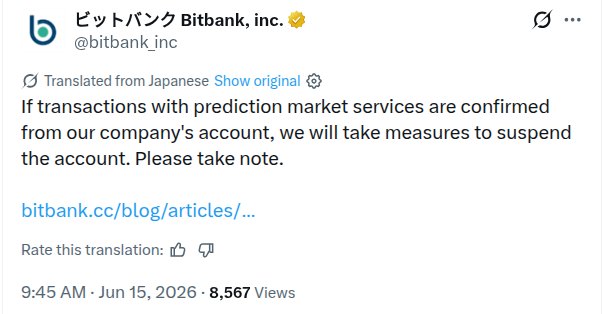 Bitbank Team Shared on X
Bitbank said in its notice:
According to the exchange, suspended accounts would lose access to all major services, including account login, cryptocurrency deposits and withdrawals, Japanese yen withdrawals, and crypto asset trading. Bitbank added that the measure forms part of its efforts to maintain compliance with applicable regulations and provide a secure trading environment for customers.
The warning represents one of the strongest positions taken by a Japanese cryptocurrency exchange against prediction market activity, reflecting increasing scrutiny of platforms that allow users to speculate on the outcomes of future events using digital assets.
Bitbank Says Prediction Market Activity May Trigger Account Restrictions
In its notice, Bitbank said users whose accounts are suspended would lose access to all major account functions, including login services, cryptocurrency deposits and withdrawals, Japanese yen withdrawals, and crypto asset trading.
The exchange identified prediction markets as platforms that enable users to speculate on the outcomes of future events using cryptocurrency. These events can range from political elections and sporting contests to economic data releases and other real-world developments.
While many prediction market operators are based outside Japan, Bitbank cautioned that Japanese residents accessing such services from within the country for financial gain could potentially be viewed as engaging in gambling-related activities under Japanese law.
Bitbank also stated that it would not be liable for any losses or damages incurred as a result of account suspension measures. However, the company noted that customers who believe their accounts were restricted in error can submit inquiries for review through its official support channels.
Exchange Cites Compliance and User Protection Concerns
According to Bitbank, the warning is part of its ongoing commitment to maintaining a safe trading environment and complying with applicable laws, regulations, and industry guidelines.
The exchange urged users to exercise caution when interacting with external services, particularly those that may carry legal or regulatory risks. Bitbank said the policy is intended to help prevent customers from becoming involved in criminal activity, fraud, or other forms of misconduct, whether knowingly or unknowingly.
The announcement represents one of the clearest warnings issued by a major Japanese cryptocurrency exchange regarding prediction market participation, highlighting the sector’s increasingly cautious approach toward potentially sensitive activities.
Regulatory Scrutiny of Prediction Markets Continues to Grow
Prediction markets have experienced significant growth in recent years, driven by platforms such as Polymarket that allow users to trade contracts tied to the outcomes of elections, economic indicators, sports events, and other future developments.
Japan has accelerated its crypto and blockchain push in recent months, with the ruling LDP outlining an AI and blockchain finance strategy in May while Polymarket signaled plans to enter the Japanese market by 2030. In June, major Japanese banks announced plans for a joint stablecoin launch by fiscal 2026, and lawmakers approved a crypto tax reform bill that could reduce taxes on Bitcoin and Ethereum gains from up to 55% to 20%.
Despite their rising popularity, these platforms continue to face legal uncertainty across multiple jurisdictions. Regulators around the world remain divided on whether prediction markets should be treated as financial products, derivatives, information markets, or forms of online gambling.
Bitbank’s latest advisory suggests that Japanese crypto service providers are taking a more conservative stance as authorities continue to evaluate the legal implications of cryptocurrency-based prediction markets. The warning also serves as a reminder that activities permitted on offshore platforms may still carry compliance risks for users operating within Japan.


You May Also Like

Justice Department has 'gone off the rails' for Trump's 'pretzel logic': analysis

Anthony Loke: LRT3 launch date to be announced in next two weeks

Airtel crosses 650 million customers globally, becomes world’s second largest telecom operator



