

Can the Indian Government Suddenly Ban Crypto in 2026?
BitcoinWorld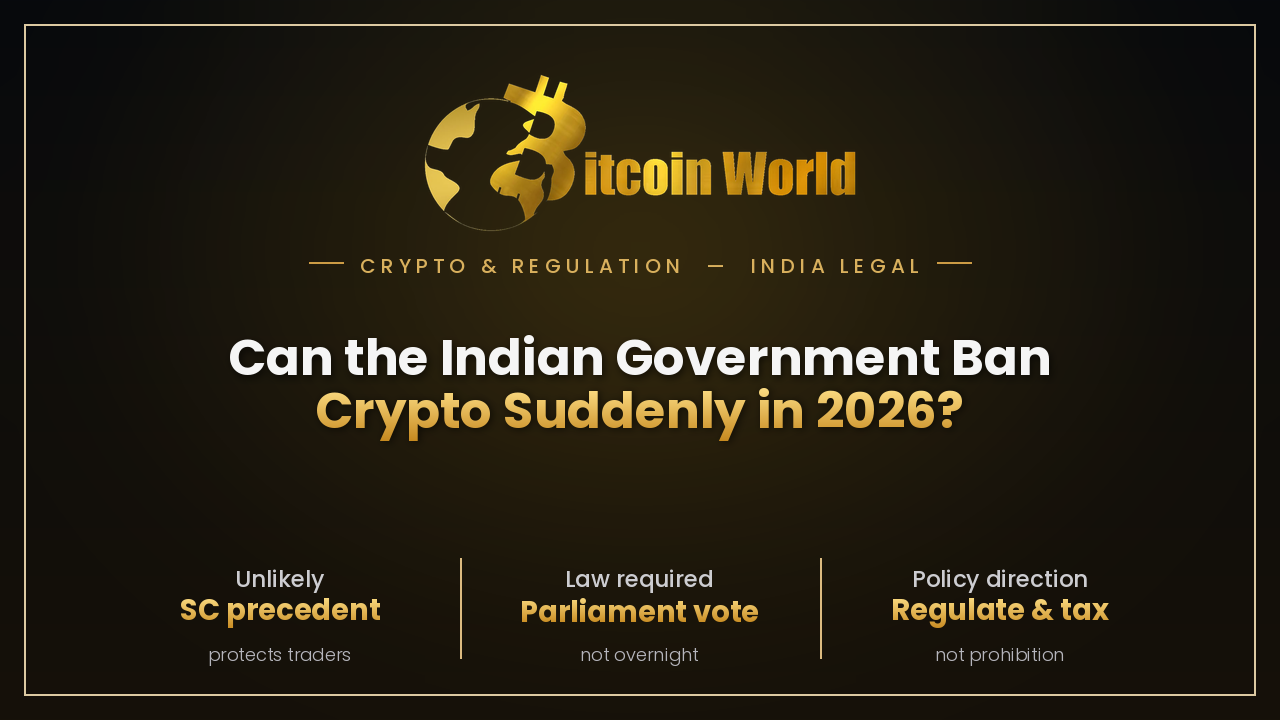
Can the Indian Government Suddenly Ban Crypto in 2026?
Can the Indian Government Suddenly Ban Crypto in 2026?
A sudden Indian government crypto ban in 2026 is unlikely – and understanding why requires looking at three converging obstacles: constitutional law established by the Supreme Court, the economic reality of over 107 million Indian crypto users, and India’s deep integration into the global regulatory frameworks that are built around regulating crypto, not eliminating it. This article examines each obstacle in detail, what a ban would actually require legally, what the government’s revealed policy preference is, and what Indian users should realistically expect from the regulatory trajectory. Verified against current sources; accurate as of June 2026.
Could the Indian Government Legally Ban Crypto Overnight?
A sudden executive crypto ban in India faces immediate constitutional barriers that did not exist before 2020.
- The 2020 Supreme Court precedent: In IAMAI v. RBI, the Supreme Court struck down the RBI’s banking ban as a violation of Article 19(1)(g) – the fundamental right to trade. Any executive action restricting crypto would now face the same constitutional challenge.
- Proportionality requirement: The Court established that restrictions must pass a proportionality test – the government must demonstrate harm severe enough to justify the restriction. A blanket ban without evidence of proportionate harm would be challenged immediately.
- Legislative route required: A constitutionally durable ban would require an Act of Parliament – a majority vote in both houses, presidential assent, and survival of judicial review.
- No current bill in Parliament: As of June 2026, no crypto prohibition bill is before Parliament. The Cryptocurrency and Regulation of Official Digital Currency Bill has been on the legislative agenda since 2021 but has never been introduced for a vote.
- Timeline for any legislative ban: Drafting, debate, passing, and commencement of a comprehensive crypto prohibition law would realistically take 12 to 24 months minimum – not overnight.
What Would a Crypto Ban Actually Look Like in India – and Who Would It Affect?
Even if a legislative ban were passed, implementation against India’s 107 million+ crypto users would be profoundly complex.
- Scale of the ecosystem: India is home to an estimated 107 million cryptocurrency users as of late 2025 – the world’s largest user base – making enforcement politically and practically costly.
- Exchange shutdown: FIU-registered exchanges could be ordered to cease operations and return INR balances – the government could enforce this relatively quickly.
- Self-custody is harder to enforce: Bitcoin, Ethereum, and other assets held in personal, non-custodial wallets would be extremely difficult to confiscate or prohibit without physically accessing every device – something no government has effectively achieved.
- Economic disruption: Billions in declared and taxed crypto assets held by Indian residents would face sudden uncertainty; tax revenue from VDA transactions would disappear.
- International exposure: Indian users with crypto on offshore exchanges could shift operations further abroad, making the regulatory framework even harder to enforce.
Why Has India Chosen Regulation Over Prohibition?
India’s revealed policy preference since 2022 is unambiguously toward regulation, not prohibition.
- Formal VDA classification (2022): Rather than banning crypto, the government formally defined it as a Virtual Digital Asset, brought it within the tax net, and assigned it regulatory status.
- Tax revenue dependency: The 30% tax and 1% TDS system generates real government revenue from crypto transactions – a ban would eliminate this income stream.
- FIU oversight investment: India has built a full compliance infrastructure – FIU-IND registration, PMLA coverage, exchange reporting obligations – representing years of policy and institutional investment that would be abandoned by a ban.
- CARF commitment: India is among 52 nations implementing the OECD Crypto-Asset Reporting Framework from April 2027 – a global data-sharing infrastructure explicitly designed around regulated crypto, not prohibited crypto.
- SEBI involvement: SEBI’s regulatory role in crypto securities signals long-term institutionalisation, not a path to prohibition.
What Is the Government’s Actual Direction for Crypto in 2026?
India’s crypto regulatory trajectory in 2026 points toward tighter compliance and eventual comprehensive legislation – not a ban.
- Comprehensive Crypto Bill (expected): A dedicated crypto law is under active discussion between the Finance Ministry, SEBI, and RBI – expected to formally define regulated digital asset categories, licensing requirements, and stablecoin rules when passed.
- Multi-regulator model: The proposed framework splits oversight: SEBI for security-like tokens, RBI for cross-border crypto flows, Finance Ministry for policy and taxation.
- SEBI DeFi and NFT sandbox: SEBI and RBI are exploring controlled sandbox programs for DeFi and NFTs – a regulatory embrace, not a prohibition.
- DeFi discussion paper expected: The government is expected to issue a discussion paper on staking and DeFi rules in 2026 – the first formal regulatory engagement with those sectors.
- G20 alignment: India holds G20 positions aligned with the FSB’s crypto regulation framework – built around oversight standards, not bans.
Frequently Asked Questions
Is there any risk that India will suddenly ban Bitcoin or crypto in 2026?
The risk of a sudden crypto ban in India in 2026 is low. The 2020 Supreme Court ruling requires any executive restriction to pass a constitutional proportionality test; a legislative ban would require months of parliamentary process; and the government’s investment in a VDA tax framework, FIU oversight, and CARF participation all signal a regulation-not-prohibition trajectory. India’s 107 million crypto users also represent a significant political constituency. A ban cannot be ruled out in the abstract, but the conditions for one are absent in 2026.
What would happen to crypto held on Indian exchanges if a ban were announced?
If a legislative ban were enacted, FIU-registered exchanges would likely be required to cease operations and return INR balances to users – giving some transition period. Crypto held in self-custody wallets would not be technically accessible to authorities without physical access to the user’s device or keys. Historically, jurisdictions that have imposed crypto bans have found enforcement against self-custody holdings very difficult. A well-prepared Indian user with self-custody holdings and an offline seed phrase backup would retain practical access regardless of exchange closure.
Has India ever actually prohibited crypto – or only restricted it?
India has never explicitly made owning or holding crypto illegal. The 2018 RBI ban targeted banking services for crypto businesses, not possession of crypto itself – and was struck down in 2020. No subsequent law has prohibited private ownership of Bitcoin or other VDAs. The closest India has come to a prohibition was the 2021 draft Cryptocurrency and Regulation of Official Digital Currency Bill, which was never introduced in Parliament. The government’s subsequent actions in 2022-2026 all moved firmly toward regulated legality, not prohibition.
Conclusion: Why a Sudden India Crypto Ban Is More Obstacle Course Than On/Off Switch
A sudden Indian government crypto ban in 2026 is not impossible in theory – but it faces constitutional barriers, a 107-million-user enforcement challenge, five years of regulatory infrastructure investment, and global commitments designed around regulated crypto that would all need to be unwound. The more probable direction is the one the government has been telegraphing since 2022: increasingly tight compliance obligations, eventual comprehensive legislation, and a regulatory environment built on taxing and tracking crypto – not eliminating it. For Indian crypto users, the right response to ban risk is not panic – it is self-custody, proper documentation, compliance with the existing framework, and engagement with the regulatory process as it develops. The rules are strict; they are also, as of June 2026, stable.
This post Can the Indian Government Suddenly Ban Crypto in 2026? first appeared on BitcoinWorld.


You May Also Like

SpaceX (SPCX) Stock: Timing Your Entry Around Earnings and Lockup Expiration

Indonesian Rupiah: BI Tightening Expected to Buffer IDR Against US Dollar Strength, Says MUFG

DeFi TVL has been on a steady monthly decline since January



