

Aave (AAVE) Price Prediction: Standard Chartered Projects $3,500 by 2030 Amid DeFi Expansion
Key Takeaways
- Geoff Kendrick from Standard Chartered has launched coverage on AAVE, projecting a $3,500 valuation by December 2030.
- This projection suggests approximately a 50-fold surge from AAVE’s present trading range of $70–$76.
- According to Kendrick, Aave has bounced back following the April KelpDAO security breach that threatened $230 million in protocol losses.
- The bullish outlook hinges on tokenized real-world assets expanding 37-fold to approximately $2.7 trillion by decade’s end.
- Incremental milestones position AAVE at $180 by late 2026, climbing to $600, $1,200, and $2,200 in following years.
Geoff Kendrick, who leads digital assets research at Standard Chartered, has launched coverage on Aave with an ambitious long-term valuation of $3,500 by December 2030. With AAVE currently hovering around $76, this projection implies an approximate 50-fold appreciation.
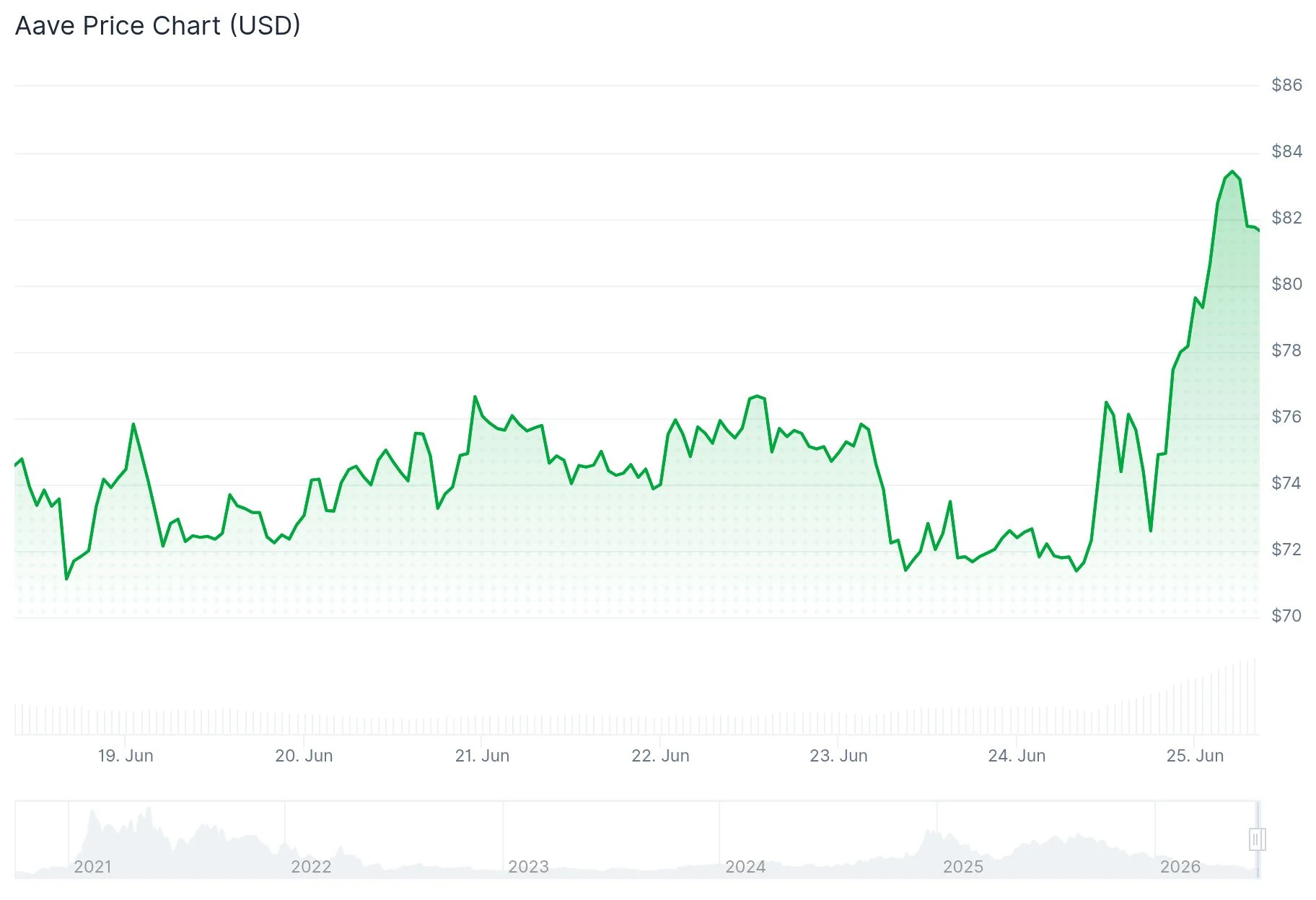 Aave Price
The projection unfolds through a multi-year timeline. Kendrick anticipates AAVE climbing to $180 by late 2026, advancing to $600 by late 2027, reaching $1,200 by late 2028, and touching $2,200 by late 2029 before ultimately achieving the $3,500 mark in 2030.
Kendrick characterized Aave as a blockchain-powered automated banking system. The protocol operates exclusively via smart contracts, eliminating traditional banking elements like human staff or subjective credit decisions.
During its October 2025 zenith, Aave commanded approximately $75 billion in total deposits. Kendrick highlighted that this deposit volume would have positioned the protocol within the top 30 U.S. banks measured by deposit holdings.
The protocol encountered significant turbulence this year. Attackers exploited a vulnerability in April, extracting roughly $292 million in rsETH through a LayerZero-connected bridge and subsequently leveraging those stolen tokens as collateral across Aave and competing DeFi protocols.
This security incident exposed Aave to potential losses approaching $230 million. Deposit levels plummeted, while active lending activity contracted. Aave responded by halting rsETH market operations.
Real-World Asset Tokenization and Aave Horizon
Standard Chartered’s extended-term thesis leans heavily on the proliferation of tokenized real-world assets. The financial institution forecasts this asset category will multiply 37-fold by 2030, approaching $2.7 trillion in total value.
Kendrick explained that Aave’s revenue framework connects directly to lending activity and deposit volumes, suggesting that expansion in tokenized markets could drive enhanced protocol earnings and subsequent appreciation for the AAVE token.
Aave Horizon, the protocol’s permissioned lending infrastructure, represents a crucial component. This platform enables vetted institutions to secure loans against tokenized real-world collateral. By late May, Horizon recorded approximately $163 million in outstanding loans, contrasted against a broader tokenized real-world asset ecosystem valued at $30 billion.
Aave’s native GHO stablecoin contributes additional strategic value. GHO circulation has expanded to roughly $600 million following its 2023 debut. Significantly, all GHO-generated fees flow entirely to the protocol instead of being distributed to external liquidity providers.
Chart Analysis and Competing Projections
AAVE has rebounded from early-June troughs around $58–$60, currently exchanging hands near $76. This represents roughly a 6.5% gain over the preceding 24-hour period.
The 4-hour chart continues displaying an overarching bearish framework following a dramatic decline from above $100 in May. Critical resistance zones appear near $75.50–$76.00. A decisive breakout beyond this threshold could trigger momentum toward $78–$80.
Grayscale’s Alternative Valuation
Grayscale Research has independently suggested AAVE may be trading below intrinsic value near $75. The research firm calculates fair value could advance toward $175 over a 12-month horizon, contingent on scenarios featuring improved regulatory frameworks and accelerated tokenized asset integration.
Standard Chartered interprets present deposit figures as a cyclical bottom and projects capital will flow back into the protocol as DeFi market conditions stabilize.
At publication time, AAVE was exchanging near $76.49.
The post Aave (AAVE) Price Prediction: Standard Chartered Projects $3,500 by 2030 Amid DeFi Expansion appeared first on Blockonomi.


You May Also Like
Digital Currency X Technology Enters Into Securities Purchase Agreement for a Private Placement of US$700 Million of Units, Payable in U.S. Dollars or Digital Assets, to Advance Its Digital Asset Treasury Strategy

Polygon Price Rises 5% After Weekly Stablecoin Record
Jeers rain down on Sean Duffy over Great American Fair remarks: 'You're garbage'



