

Gold Price Prediction: Can $4,000 Support Hold as Bears Target $3,400?
Gold is trading near $4,209, leaving investors divided over whether the recent correction marks the end of the bull cycle or a reset before another move higher. The metal remains well below its January record above $5,590, pressured by elevated real yields, a stronger dollar, and a more hawkish Federal Reserve outlook.
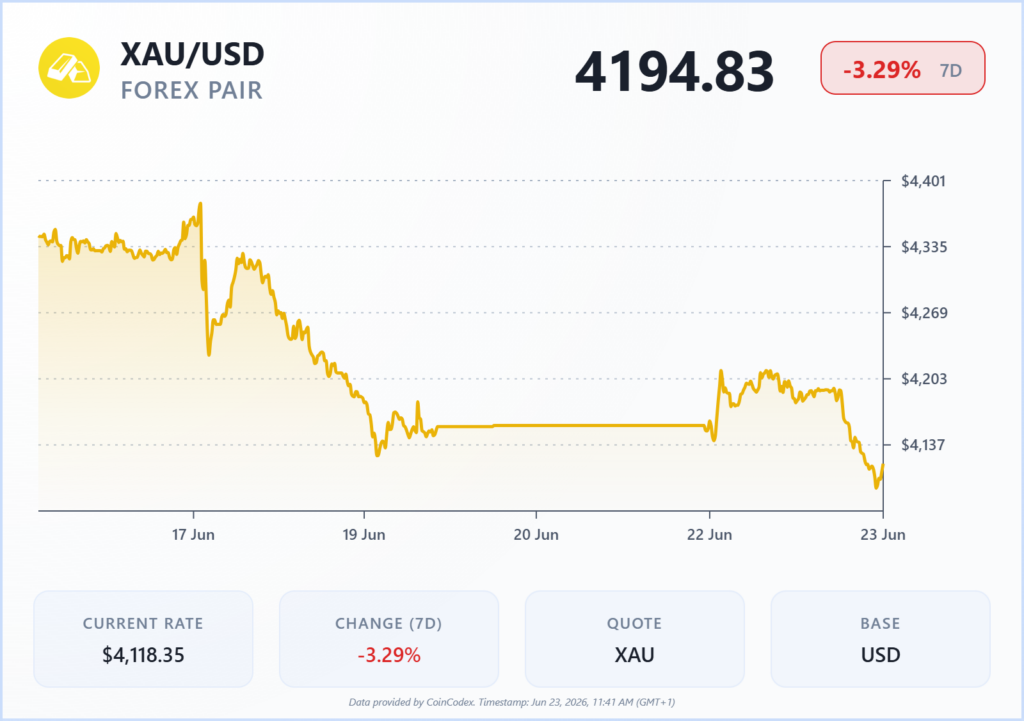
Gold Faces Death Cross Risk as $4,000 Support Comes Into Focus
The near-term gold price prediction has turned more cautious as the metal trades below its 200-day moving average. The 50-day and 200-day moving averages are now converging near the $4,300 to $4,400 region, raising the risk of a death cross.
That setup would reinforce the bearish technical structure already visible on the chart. Gold has repeatedly failed to reclaim the $4,300 zone, which now acts as resistance after previously serving as support. A daily close above $4,300 to $4,400 would weaken the bearish case, but until then, sellers remain in control.
The key downside level is $4,000 to $4,100. If that zone fails, bearish targets around $3,440 come into play, aligning with Fibonacci extension analysis and the World Gold Council’s reflation downside scenario. That would imply a deeper correction of roughly 18% from current levels.
Central Banks Keep the Long-Term Bull Case Alive
Despite the bearish chart setup, gold’s structural story remains stronger than a typical cycle-top decline. Central banks bought a net 244 tonnes in the first quarter of 2026, up from 208 tonnes in the previous quarter. That demand continues to create a floor beneath the market.
The current correction is being driven mostly by rate-sensitive Western capital reacting to higher real yields. Central banks, by contrast, are buying gold for reserve diversification and de-dollarization purposes, which makes their demand less sensitive to short-term price swings.
That explains why major institutional forecasts remain above spot. J.P. Morgan sees gold potentially moving toward $5,000 to $6,300 in 2026, Goldman Sachs targets $4,900, UBS projects as high as $5,900 by December, and Morgan Stanley’s more cautious $5,200 target still implies upside from current levels.
CoinCodex Gold Price Prediction
According to the latest CoinCodex gold price prediction, the metal could remain under pressure through the rest of 2026 before attempting a partial recovery in early 2027.
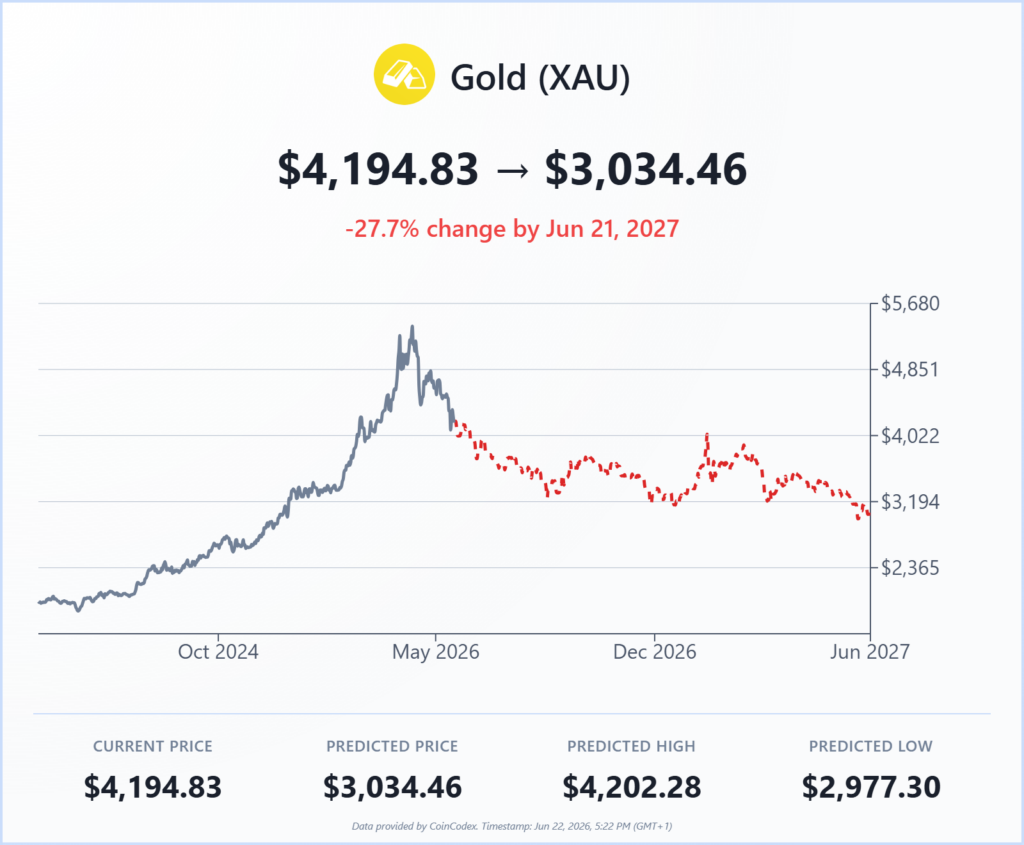
The forecast shows June holding close to current levels, with an average price near $4,095 and a maximum target around $4,202. From there, the model turns more bearish. July’s average forecast slips to about $3,866, while August and September point to deeper weakness, with average prices falling toward $3,645 and $3,434.
The weakest stretch appears in December 2026, when CoinCodex projects an average gold price of roughly $3,304 and a minimum near $3,153. That path broadly supports the bearish technical view that a break below $4,000 could accelerate selling pressure.
However, the forecast also suggests gold may avoid a straight-line decline. January 2027 shows a possible rebound toward a maximum of $4,040, indicating that buyers could return after a sharp year-end correction. Even so, the broader CoinCodex outlook remains cautious, with June 2027 projections pointing to average prices near $3,131.
The post Gold Price Prediction: Can $4,000 Support Hold as Bears Target $3,400? appeared first on Blockzeit.


You May Also Like

Supreme Court Allows Trump Admin To Remove Deportation Protections For Syrians & Haitians

UK FCA May Exempt Crypto Firms from Key TradFi Rules — What’s at Stake?

Hormuz traffic sees sharp uptick but not back to normal



