Crypto News Today: Bitcoin at $60K, ETF Outflows Hit $1.79B, and CLARITY Act Odds Slashed
Bitcoin and crypto are opening a new week today with very low sentiment and trading volume. The Fear and Greed Index sits at 16 – deep in “Extreme Fear” territory. Anything below 25 is considered extreme fear, so this confirms we are firmly in a bear market.
The total crypto market cap hit a yearly low last week. Bitcoin is struggling to hold above $60,000. Ethereum is below $1,600.
But there is still important crypto news to cover. Let us dig into it.
Loopring Shuts Down DEX – zkEVM Has Overtaken Its Architecture
Loopring, one of Ethereum’s earliest zkRollup projects, announced it is shutting down the Loopring DEX effective immediately, with its relayer going offline.
The team said Loopring was among the first projects to demonstrate that zero-knowledge proofs could scale Ethereum. But its non-EVM architecture, limited adoption, weak business development, and major LRC exchange delistings in 2026 ultimately led to its closure.
Loopring will publish users’ final balances before distributing assets worth at least $10 directly to their associated Ethereum L1 addresses, with all gas fees covered by the team.
This is a reminder of how fast the crypto landscape evolves. Early pioneers can become obsolete as the market consolidates around dominant standards like zkEVM.
We just published some crypto price predictions for today too.
Spot Bitcoin ETFs Hit $1.79B in Outflows Last Week
From June 22 to June 26, spot Bitcoin ETFs recorded net outflows of $1.79 billion – the third-highest weekly net outflow on record.
Spot Ethereum ETFs had net outflows of $273 million, extending their outflow streak to seven consecutive weeks.
Spot XRP ETFs recorded net inflows of $22.99 million, while spot HYPE ETFs had net inflows of $111 million.
The divergence is clear. Institutions are selling Bitcoin and Ethereum. They are buying XRP and Hyperliquid. Rotation is happening, but the overall trend is risk-off.
Pi Network Celebrates Pi2Day With New Releases
Pi Network is celebrating Pi2Day with new releases advancing Pi’s practical utility both within and beyond the Pi ecosystem, across compute, AI, and identity.
The new releases include:
- SoloHost – A new service for hosting Pi nodes
- Pi Sign-in – Simplified authentication
- PiVerify – Identity verification tools
Pi Network also launched a Pi2Day Ecosystem Quest to help users learn about the new releases and earn a special in-app badge.
This is a positive development for Pi Network’s ecosystem, but the token is still not listed on major exchanges.
Galaxy Research Cuts CLARITY Act Passage Odds to 50%
Galaxy Research Head of Research Alex Thorn said the firm has lowered its odds of the CLARITY Act becoming law in 2026 from 60% to 50% , due to a tightening Senate calendar and limited progress in negotiations.
Thorn said the downgrade is mainly about timing, not the substance of the bill. The CLARITY Act passed the Senate Banking Committee on May 14 and has been on the Senate Legislative Calendar since June 1, but no floor date has been set and no unified Banking-Agriculture text has been released.
He said ethics issues and developer-protection language remain unresolved. The SAVE Act, the housing bill standoff, FISA Section 702 reauthorization, and the FY2027 NDAA are all competing for Senate floor time. Without a floor schedule by early July, the bill’s path could slip to September.
Julien’s Viral Thread: Bitcoin Below Production Cost Is the Bottom
Analyst Julien posted a viral thread on X that is worth reading carefully.
The cost of manufacturing Bitcoin is $78,000. It is being dumped at $63,000.
The weakest miners are dying off. They shut down their machines. They sell their last bitcoins to survive. 32,000 BTC dumped in a single quarter – a record, worse than in 2022.
Julien says: “It’s ugly, it’s brutal, and it’s exactly what I want to see. Because this isn’t a market that’s dying. This is a market squeezing out its weak hands.”
He also addressed the $40,000 Bitcoin prediction. Below the production cost, every miner that shuts down pulls Bitcoin off the market. The supply dries up right when everyone is panicking. It is mechanical. That is what forms a floor.
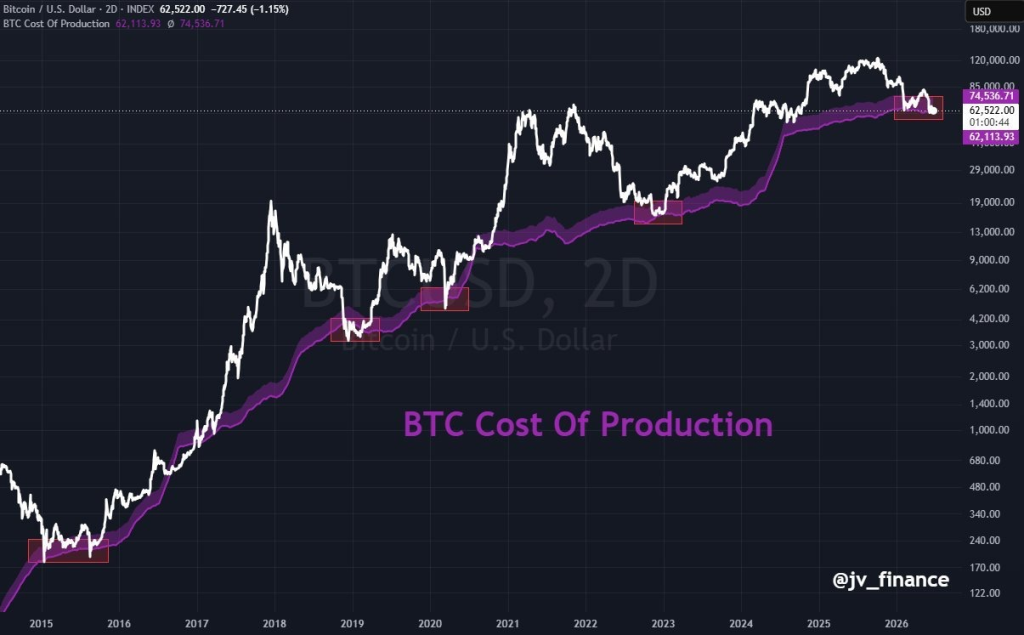
2015, 2019, 2022 – every time the price dipped below production cost, it was the bottom. Not the start of the fall.
He concluded: “Some wait for a $40,000 that won’t come. I’m scooping up Bitcoin cheaper than it costs to produce.”
BTC Chart Analysis: Bitcoin at Production Cost for the Fifth Time
The chart Julien shared shows Bitcoin’s price alongside the production cost line. The bottom line is the estimated production cost. Every time Bitcoin has touched that line in the past ten years, it has marked a bottom.
- 2015: Price touched production cost → bottom
- 2019: Price touched production cost → bottom
- 2022: Price touched production cost → bottom
- 2026: Price is touching production cost again
 Source: X/@realcryptoboost
The chart suggests that Bitcoin is at a historically significant level. The production cost acts as a floor because miners cannot sustain losses indefinitely. When they shut down, supply tightens.
Julien’s message: “Today we’re there for the fifth time. Tell me this time it’s different. I’m waiting.”
Read also: ChatGPT Predicts the Price of Bitcoin Before the End of July
Upcoming Week: Volatility Expected
The upcoming week brings several events that could trigger volatility:
July 1:
- Binance (and others) lose EU crypto access (MiCA expiry)
- US ISM Reading
July 2:
- Supreme Court ruling deadline for Epstein files on Trump
- Unemployment Claim Reading
July 3:
- Bank Holiday
July 4:
- US Birthday Holiday
Expect volatility. The MiCA expiry could disrupt EU crypto access. Economic data could move markets. And the Supreme Court ruling deadline could create uncertainty.
Where Could Bitcoin Go From Here?
Julien’s argument is compelling. Bitcoin is trading below production cost. Historically, that has marked bottoms. The miners are capitulating – 32,000 BTC dumped in a single quarter is a record. That kind of selling pressure is usually the final phase of a bear market.
However, the macro environment remains hostile. ETF outflows are at record levels. The CLARITY Act is stuck. The Fed is hawkish.
Short-term: Bitcoin could test $60,000 again this week. A break below that could trigger another wave of liquidations. The MiCA expiry on July 1 and economic data on July 2 could be catalysts for a move.
Medium-term: If Julien’s historical pattern holds, the bottom is near. The production cost floor at $78,000 indicates that current prices are unsustainable for miners. Once weak hands are flushed, the supply shock could trigger a recovery.
The big question: Will this time be different? Julien says no. History indicates the production cost floor holds. But the macro environment is more challenging than in previous cycles. That is the risk.
Subscribe to our YouTube channel for daily crypto updates, market insights, and expert analysis.
The post Crypto News Today: Bitcoin at $60K, ETF Outflows Hit $1.79B, and CLARITY Act Odds Slashed appeared first on CaptainAltcoin.


You May Also Like

Ken Griffin Just Sold 40% of His Palantir (PLTR) Stock — Should You?

Binance Perpetual Futures Revolution: QQQ and Major US Stocks Enter Crypto Derivatives Market with 10x Leverage