Australia’s Crypto Travel Rule Takes Effect: Key Changes Explained
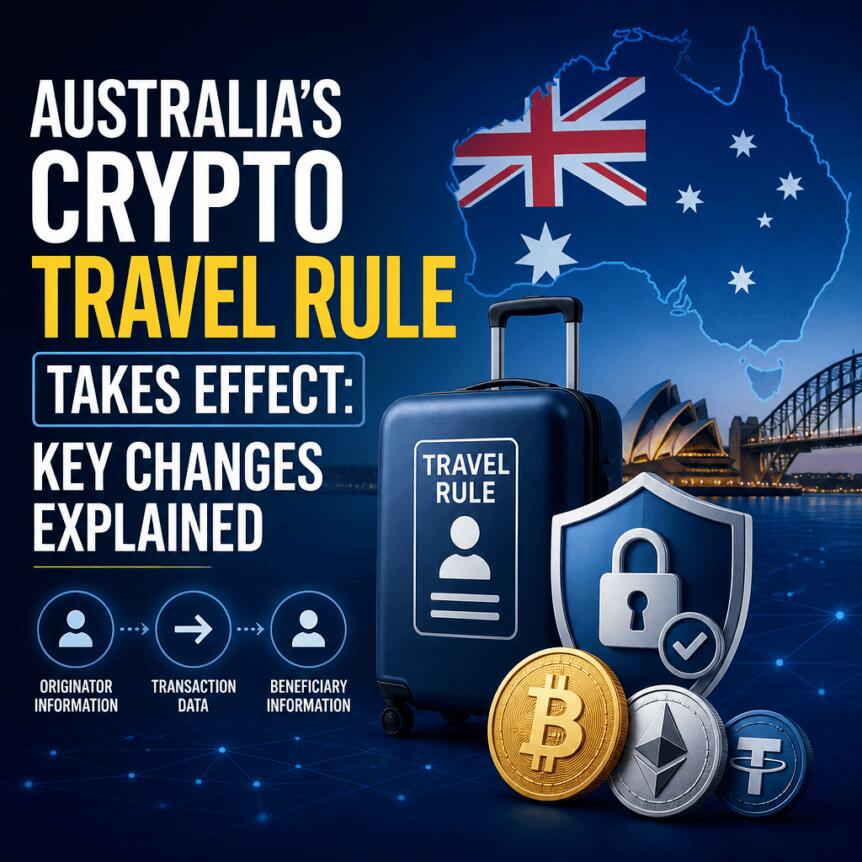
Australia’s “travel rule” for cryptocurrency transfers is set to take effect on Wednesday, tightening how regulated exchanges handle information when users send and receive digital assets. The change is designed to improve traceability of transfers and reduce opportunities for money laundering, terrorist financing, and crypto-enabled scams.
From July, crypto moved to and from locally regulated exchanges will require users to provide extra data—such as the counterparty’s name and the platform involved. While the added steps raise concerns for users who value privacy, industry representatives say the process is largely a one-time confirmation for many customers.
Key takeaways
- Australia’s travel rule begins Wednesday, bringing the country in line with similar requirements already used in the EU, US, and UK.
- Starting in July, transfers involving Australian regulated exchanges will require additional originator/beneficiary information to be collected.
- Transfers from regulated exchanges to self-custodial addresses will include a verification step to confirm users control the destination wallet.
- There is no minimum transaction size threshold, meaning information gathering applies to transfers of any value.
- Enforcement falls under AUSTRAC, Australia’s financial intelligence agency.
What the travel rule changes for Australian users
The travel rule is a compliance framework intended to make crypto transfers more traceable by ensuring exchanges exchange relevant beneficiary and originator data alongside transactions. According to information cited by Cointelegraph, the broader concept traces back to the Financial Action Task Force (FATF), which first extended travel rule expectations to crypto in 2019.
In practice, Australia’s implementation targets transfers that touch regulated entities. As of July, customers sending or receiving cryptocurrency through locally regulated crypto exchanges will need to submit additional information—such as the name of the person on the other side of a transfer (or receiving party) and the platform name—so that exchanges can build an auditable record of counterparties.
Gabby Lewis, head of fraud and financial crime at Swyftx, told Cointelegraph that for most exchange users the change should be manageable. She said customers typically “provide the required details once,” after which the information can be reused for later transfers, reducing friction over time.
No minimum threshold: a key difference versus some countries
One of the most significant features of Australia’s rules is that there is no minimum value threshold. That means exchanges must capture the required information for transfers regardless of size, aligning Australia with jurisdictions that similarly do not limit travel rule requirements by transaction value.
Other countries, by contrast, have set thresholds. The US, for example, collects information only once transfers start at $3,000, according to details referenced in Cointelegraph’s reporting. The absence of a threshold in Australia increases the compliance scope for ordinary users—particularly those who send smaller amounts frequently.
How the rule applies to self-custody
The travel rule does not only affect transfers between exchanges. Australia’s framework also requires verification steps when cryptocurrency leaves a regulated platform and goes to a self-custodial address, such as a cold storage wallet.
Cointelegraph reports that in these cases users must verify and declare ownership of the address they are sending to. Lewis described this as a “quick confirmation” that the wallet belongs to the customer, with the most noticeable additional steps reserved for transfers that involve another party or another exchange.
For users, this distinction matters: moving to self-custody may reduce counterparty data being transmitted to other institutions, but it does not eliminate verification requirements when interacting with regulated exchanges.
Enforcement and industry rollouts
Australia’s travel rule will be enforced by AUSTRAC, the country’s financial intelligence agency. The regulator’s role is central to how exchanges will structure compliance checks, and it also signals how strictly the rules may be applied over time.
While the full rollout is linked to the new legal requirements, some Australian exchanges have begun implementing travel rule processes ahead of Wednesday’s start date. Cointelegraph noted that Kraken started applying the rule on March 31, while CoinJar began on Tuesday. That early adoption suggests exchanges may already be building workflows for gathering and storing required counterparty information.
These staggered timelines also point to a transition period for users: depending on where they trade, customers may encounter travel-rule prompts earlier or later than the nationwide baseline.
Privacy concerns and why the debate is unlikely to fade
The travel rule has long been a flashpoint within crypto communities because it increases the amount of data exchanged and recorded during transfers. Users have worried that tying crypto movements to personal information could undermine anonymity and create risks if data is linked, exposed, or misused.
Yet Lewis emphasized that the travel rule is not “crypto-specific.” As Cointelegraph reported, the concept is broader and already applies across many financial services. She also said Australia is “following suit,” listing examples of other markets where similar approaches are already in place, including Singapore, the United States, New Zealand, and the UK.
Crypto users’ reactions in Australia have been mixed as the implementation approaches. Reddit threads referenced by Cointelegraph included comments arguing that anonymity would effectively disappear, alongside pushback insisting that regulated platforms were never fully anonymous to begin with.
For investors and active traders, the practical takeaway is not only the new requirement itself, but how exchanges will operationalize it: what information gets requested, when prompts appear, how wallet verification is handled, and whether counterparties’ details are stored for reuse. Those details can materially affect user experience, particularly for people making frequent transfers or interacting with multiple counterparties.
As implementation ramps up, users should watch for how regulated platforms handle travel-rule prompts, whether address verification becomes frictionless in practice, and how data collection processes evolve under AUSTRAC oversight. The rules remove a layer of transactional privacy from exchange-to-exchange and exchange-to-self-custody flows—but the extent of real-world impact will largely depend on how smoothly exchanges implement the new data requirements.
This article was originally published as Australia’s Crypto Travel Rule Takes Effect: Key Changes Explained on Crypto Breaking News – your trusted source for crypto news, Bitcoin news, and blockchain updates.


Ayrıca Şunları da Beğenebilirsiniz

Why The Green Bay Packers Must Take The Cleveland Browns Seriously — As Hard As That Might Be

Crypto Hack: Drift Protocol Drained Over $200M in Private Key Breach