Strategy’s Capital Restructure Signals Shift Away From “Death Spiral” Risk
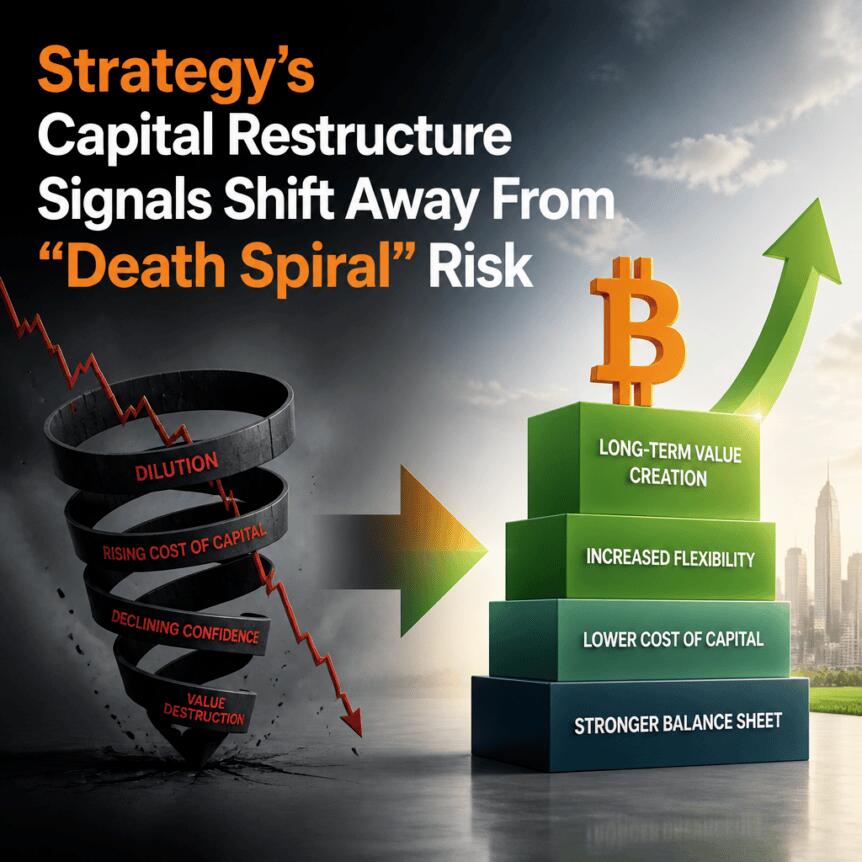
Strategy, the publicly traded firm behind the Strategy (formerly MicroStrategy) Bitcoin treasury model, has moved to reassure investors after a steep drop in both Bitcoin and its own shares intensified fears about the company’s complex capital structure. With Bitcoin trading below $60,000 and Strategy’s stock down more than 70% from its highs, attention has turned to STRC—Strategy’s preferred-like security—and the possibility that its funding mechanics could amplify downturns.
On Monday, Strategy unveiled a new capital framework designed to address concerns around liquidity, financing reflexivity, and the company’s ability to meet obligations during stress. The plan includes up to $1 billion of buybacks for MSTR, up to $1 billion of buybacks for STRC and related securities, an increase in STRC’s dividend to roughly 12%, and expansion of the company’s cash buffer to $2.55 billion. Strategy also disclosed that it may sell up to $1.25 billion in BTC holdings if needed to satisfy dividend or debt requirements.
Key takeaways
- Strategy’s new framework combines buybacks (MSTR and STRC) with a larger cash reserve, aiming to reduce uncertainty during market stress.
- STRC’s dividend is expected to rise to roughly 12%, supported by expanded cash resources under the plan.
- Strategy added a contingency option: selling up to $1.25 billion in Bitcoin if required for dividend or debt obligations.
- Short-term trading activity improved after the announcement, with STRC and MSTR both rallying more than 12% in after-hours trading, according to Yahoo Finance.
- Debate continues over whether the company’s structure can withstand prolonged tightening in funding markets—even if it is not expected to face near-term insolvency.
What Strategy outlined in its capital framework
Strategy’s announcement centers on a restructuring of how it intends to manage risk across its Bitcoin-linked balance sheet and its layered security offerings. The company says the package includes up to $1 billion in buybacks for MSTR and up to $1 billion in buybacks for STRC and related securities.
In addition to buybacks, Strategy is increasing the STRC dividend rate to roughly 12% and expanding its cash buffer to $2.55 billion. Strategy’s filing—an 8-K submitted June 29—spells out the mechanics and priorities management would follow in its capital allocation framework, including an emergency pathway that allows BTC sales if needed to meet obligations.
Crucially for investors who worry about “reflexive” downside dynamics, Strategy also said it may sell up to $1.25 billion in BTC holdings to meet dividend or debt requirements. That disclosure is notable given Strategy’s long-standing “Bitcoin maximalist” positioning and the recurring argument that selling BTC during stress could worsen market conditions.
Following the release, markets reacted positively. As reported with reference to Yahoo Finance, STRC and MSTR shares rose more than 12% in after-hours trading. The piece notes STRC was trading at $84.86 after the announcement, up from $72.06 on June 26.
Why STRC is a flashpoint for investors
STRC sits in the middle of Strategy’s capital structure—positioned as a perpetual preferred-like instrument linked to the broader Bitcoin treasury strategy. Strategy describes STRC as paying an annual dividend of about 12% on a $100 par value, supported by cash and its Bitcoin-linked capital framework.
This design has drawn skepticism from critics who argue that the instrument’s stability depends less on Strategy’s underlying solvency and more on the health of secondary-market demand and liquidity conditions. In other words, even if STRC is not a classic stablecoin, its market behavior can still be sensitive to tightening access to capital.
Earlier concerns have focused on how Strategy’s treasury approach could interact with market stress. Bitcoin critic Peter Schiff has repeatedly challenged Strategy’s model, warning that Strategy can’t sell Bitcoin without negatively affecting Bitcoin’s price and pointing to potential spillover effects if purchasing activity slows or selling accelerates.
At the same time, some analysts and market participants argue the risk framing is overstated. Taran Dhillon, head of digital assets at Kula, told Cointelegraph that Bitcoin volatility alone is unlikely to break the structure; he suggested the more important test is whether Bitcoin remains under pressure while funding becomes progressively more expensive or difficult.
The bear case: liquidity dependency and potential feedback loops
Much of the controversy around Strategy’s structure relates to how its financing cycle can behave in both directions. The core bear argument is that the same momentum that fuels expansion in calmer conditions can intensify stress when investors pull back, funding costs rise, or liquidity in secondary markets deteriorates.
Cointelegraph reported that Brad Garlinghouse, CEO of Ripple, made a similar point on CNBC, criticizing financial engineering as a driver of long-term value. Kyle Rodda, senior analyst at Capital.com, characterized Strategy as a momentum-driven accumulation vehicle: capital raises funds for Bitcoin purchases, and those purchases support the company’s valuation. But he warned the dynamic can reverse when market conditions weaken, funding costs rise, and investor appetite declines.
Rodda also emphasized that secondary market liquidity is a structural dependency. If refinancing pressures or forced selling forces larger adjustments elsewhere, the spillover effects could extend beyond Strategy itself.
Some prominent Bitcoin commentators have compared the scenario to prior stress-tested leveraged structures in crypto. Charles Edwards, founder of Capriole Investments, has been among the critics drawing parallels to Terra/LUNA-era dynamics during drawdowns, framing the situation as potential “feedback loop” risk rather than a purely price-driven story.
The neutral and bull positions: stress may target funding markets first
Not all observers agree that the primary threat is Bitcoin price movement. Dhillon suggested that any early instability would likely show up first in funding conditions—such as widening discounts, higher yields, and reduced issuance capacity—rather than immediate solvency failure tied directly to Bitcoin valuation.
He also highlighted a key distinction: STRC is not a stablecoin pegged mechanically to $100. Instead, its yield profile is designed to adjust with market pricing. The logic, in theory, is that when STRC trades below par value, the effective yield becomes more attractive to buyers, eventually pulling pricing back toward $100.
Cointelegraph also referenced a Bitfire Research report shared with the outlet, which argued that recent STRC price dislocations should not automatically be treated as structural failure. The report stated that Strategy faces no near-term insolvency risk, attributing de-pegging events largely to sentiment and liquidity conditions rather than a sudden change in fundamentals or solvency profile.
On the bull side, the article describes a “three-year MSTR stress test” conducted by Bitcoin supporter Adam Livingston. His model assumes extreme conditions—including a 55% Bitcoin drawdown, closed capital markets, and continued cash burn requiring large Bitcoin sales. The simulation also tracks a dramatic compression in “common equity Bitcoin exposure” (CEBE) and estimates that Strategy would sell approximately 115,727 BTC over three years to meet obligations before stabilization returns.
In Livingston’s scenario, the company survives the cycle and ends with over 700,000 BTC on its balance sheet, with a recovering net asset structure once conditions normalize. The takeaway from this model, regardless of how an investor views its assumptions, is that proponents believe the balance-sheet framework could be robust enough to survive even severe drawdowns—particularly if contingency mechanisms are executed as planned.
What changed—and what remains uncertain
Strategy’s new framework can be viewed as an attempt to make its stress-response playbook more concrete. According to the article’s references to Strategy’s June 29 8-K filing, management is focusing on transparency around how it would act during liquidity or capital-market disruptions—especially through cash buffer expansion, buybacks for both MSTR and STRC, and the ability to monetize Bitcoin up to $1.25 billion if required.
Dhillon described the changes as a meaningful improvement to transparency and confidence, pointing to the enlarged $2.55 billion reserve and a clearer plan for how Bitcoin monetization would work under pressure.
However, critics argue the fundamental dependency remains. Schiff, as cited in the piece, pointed to market-cap vs. Bitcoin value asymmetries—arguing that as long as MSTR’s market cap remains below the value of its Bitcoin holdings, newly issued capital could imply a “negative Bitcoin yield.” In other words, for some skeptics, the debate is not whether contingency tools exist, but whether the market structure will persistently price exposure in a way that helps—or harms—long-term holders.
Ultimately, Strategy’s framework strengthens the company’s toolkit for short-term stress, but it does not remove its reliance on access to capital markets over time. The key unresolved question is whether expanded liquidity buffers, buybacks, and contingency BTC sales can stand up to a prolonged period of tightening across both equity and credit-style markets—precisely the environment where feedback-loop concerns tend to matter most.
For investors, the next watch items are straightforward: whether STRC’s pricing relationship to par value stabilizes, how funding conditions evolve if Bitcoin stays under pressure, and whether Strategy’s disclosed order of operations holds up in practice during the next stress test.
This article was originally published as Strategy’s Capital Restructure Signals Shift Away From “Death Spiral” Risk on Crypto Breaking News – your trusted source for crypto news, Bitcoin news, and blockchain updates.


Ayrıca Şunları da Beğenebilirsiniz

Australia weighs break-up of Big Four accounting firms after scandals

Anwar calls for fairer global financial system as AI reshapes finance