Will Bitcoin have another hard fork summer with BIP-110?
Just as BTC is struggling to regain the $60,000 level, another hard fork is looming. The BIP-110 proposal, aiming to remove ordinals and NFT, attempts to gain support from miners, or create a chain split in August.
BTC is facing another community split, escalating the simmering conflict between Bitcoin maximalists and the users of NFT and ordinals. On-chain data, with additional text or images, has been a contentious issue on the general mission of the Bitcoin network.
The BIP-110 supporters are strictly in favor of BTC as a payment network, and consider all other types of data as spam.
BIP-110 has an activation date sometime in early August, at block height 961,632. As the date approaches, the proposal is seen as a potential source of chaos for the Bitcoin network, as well as a split in the community.
More than 67% of Bitcoin traffic is still tied to ordinals and runes
On Bitcoin, ordinals and runes still make up over 67% of transactions. As the chain currently operates with extremely low fees, it is once again viable to post content in blogs.
The Bitcoin network produces $2.3M in daily fees, with over 621K transactions per day. Over 91% of blocks are full, showing no idle capacity on the network.
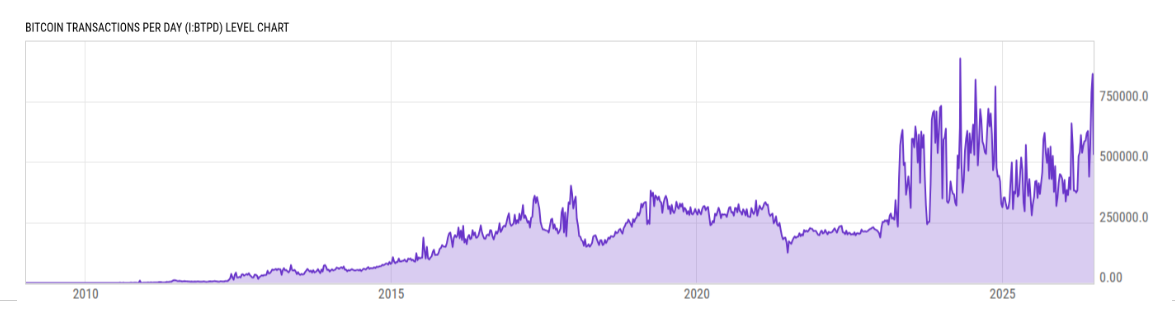 The Bitcoin network carries over 621K transactions daily, while the mempool is currently not overwhelmed by ordinals and runes transactions. | Source: Ycharts
The Bitcoin network has so far supported payment, trading, and whale traffic, despite the presence of several types of inscriptions. While the NFT market slowed down, the minting of tokens, ordinals, and other items has continued. The BTC mempool remains uncongested, and for some, the additional transactions are legitimate and support the network.
BIP-110 makes a stand against spam
Ordinals, runes, and NFT have been dismissed as unnecessary or even harmful. According to Blockstream’s Adam Back, the network should not carry spam transactions.
Some of the previous forms of on-chain messaging, like the Op_return option, have been abused as a way to claim ownership of old inactive wallets. Even with BIP-110, there are other ways to attach messages and content in a Bitcoin block, creating a new source of spam.
Will BIP-110 pass?
The expectation of BIP-110 supporters is that enough nodes will support the update. However, in reality, BIP-110 signaling was minimal, suggesting only a handful of miners and nodes may support the network.
Even with the arrival of the activation date, miners may continue approving regular blocks. At the same time, dedicated BIP-110 blocks may start creating a new soft fork and approving the specific blocks after the activation block.
In that scenario, the Bitcoin network may find itself split into two versions, one still carrying ordinals. The potential conflict recalls the summer of hard forks, where Bitcoin Cash could not out-compete other nodes for the longest chain, and split off as a hard fork.
While BIP-110 may not pass by consensus, it may still exist with some support from nodes and miners. For users, the immediate effect is that some BTC wallets may break, so using the network should be done with caution around the activation date.
Even the Bitcoin Knots wallet, proposed as part of the BIP-110 package, may break and make some coins unspendable. The other possibility is that the new soft fork will not have enough activity, and it will eventually stop block production.
The smartest crypto minds already read our newsletter. Want in? Join them.


Ayrıca Şunları da Beğenebilirsiniz

Ares Strategic Mining Establishes New Investor Relations Team Following $10 Million Funding

Marvell Stock Rose 7% After UBS Backed a $340 Target on CXL. Here’s Where the Stock Could Go