

Morgan Stanley resets Southwest Airlines stock price target
Southwest Airlines has spent the past year and a half tearing up its own playbook. For a company that built its identity on being different from every other airline, that is a big deal.
Now Wall Street is starting to agree the bet is paying off.
Morgan Stanley just gave Southwest Airlines (LUV) a fresh look, and the note that came out of it raises a question for anyone holding the stock or thinking about buying it.
Is this the start of a turnaround, or just a sugar rush from lower jet fuel and a weaker competitor going out of business?
Why Southwest changed its playbook in the first place
For most of its history, Southwest Airlines ran one product, one way.
Open seating. No first class. No bag fees.
It worked for decades and built a fiercely loyal customer base. But that loyalty had a limit.
Southwest CEO Bob Jordan said at Bernstein's 42nd Annual Strategic Decisions Conference on May 28 that internal research found 80% of customers wanted assigned seating, and 88% of people who refused to fly Southwest cited that single reason.
Related: Southwest’s big quarter comes with a catch
Families, in particular, disliked not being able to guarantee seats next to their kids.
So Southwest flipped the switch. Overnight, on Jan. 27, it rolled out assigned seating, new boarding groups, bag fees, and extra legroom options all at once.
Jordan told the Bernstein audience that Southwest led the industry in on-time performance and had the fewest cancellations on that very first day, calling the execution better than he expected.
"And the first day of operation, we led the industry in on-time performance, and we led the industry in the lowest number of cancels," Jordan stated. "So we beat the industry on the day we changed everything about how the company operates."
The early payoff has been real.
- Jordan said business revenue climbed 25% year over year in March, a trend that held through April and May.
- Rapid Rewards enrollments jumped 37% in the first quarter, and satisfaction scores for elite tier customers topped 90%.
What Morgan Stanley's new take on Southwest actually says
Morgan Stanley (MS) analyst Ravi Shanker and his team visited Southwest's Dallas headquarters, meeting with Chief Financial Officer Tom Doxey and investor relations lead Danielle Collins, according to a Morgan Stanley research note dated June 30.
The bank kept its overweight rating and set a price target of $60, up from a prior target, with shares closing at $50.25 on July 2.
Morgan Stanley's team came away convinced the airline has, in the analysts' words, gotten its momentum back.
The firm pointed out that the share of passengers paying extra for add-ons such as better seats has jumped from under 20% before the changes to 60% now, and Morgan Stanley sees no sign that number has topped out.
More Airlines:
- Another low-cost airline leaves 6 cities, refunds available
- Delta Air Lines cuts two flights forever, refunds available
- Spirit Airlines won’t be coming back, and that costs flyers money
Early worries that the new fees would push customers away have flipped into the opposite problem for competitors: Southwest appears to be gaining corporate travel share instead of losing it.
The bank also flagged that Southwest has quietly pulled back at secondary hub airports, including Chicago O'Hare and Washington Dulles, while pouring capacity into stronger markets such as Orlando, Las Vegas, San Diego, and Austin.
Southwest's overlap with bankrupt rival Spirit Airlines dropped from about 30% to 15% by the time Spirit exited the market, a shift Morgan Stanley views as a tailwind for pricing.
Looking ahead, Morgan Stanley's analysts want to see whether Southwest can restore its full-year guidance and its former target of a 10% operating margin, which management told the bank it is actively discussing if conditions remain stable.
The firm's price target implies Southwest trading at roughly 15 times normalized earnings, in line with legacy carriers Delta Air Lines and United Airlines, whose stocks already trade at that premium multiple.
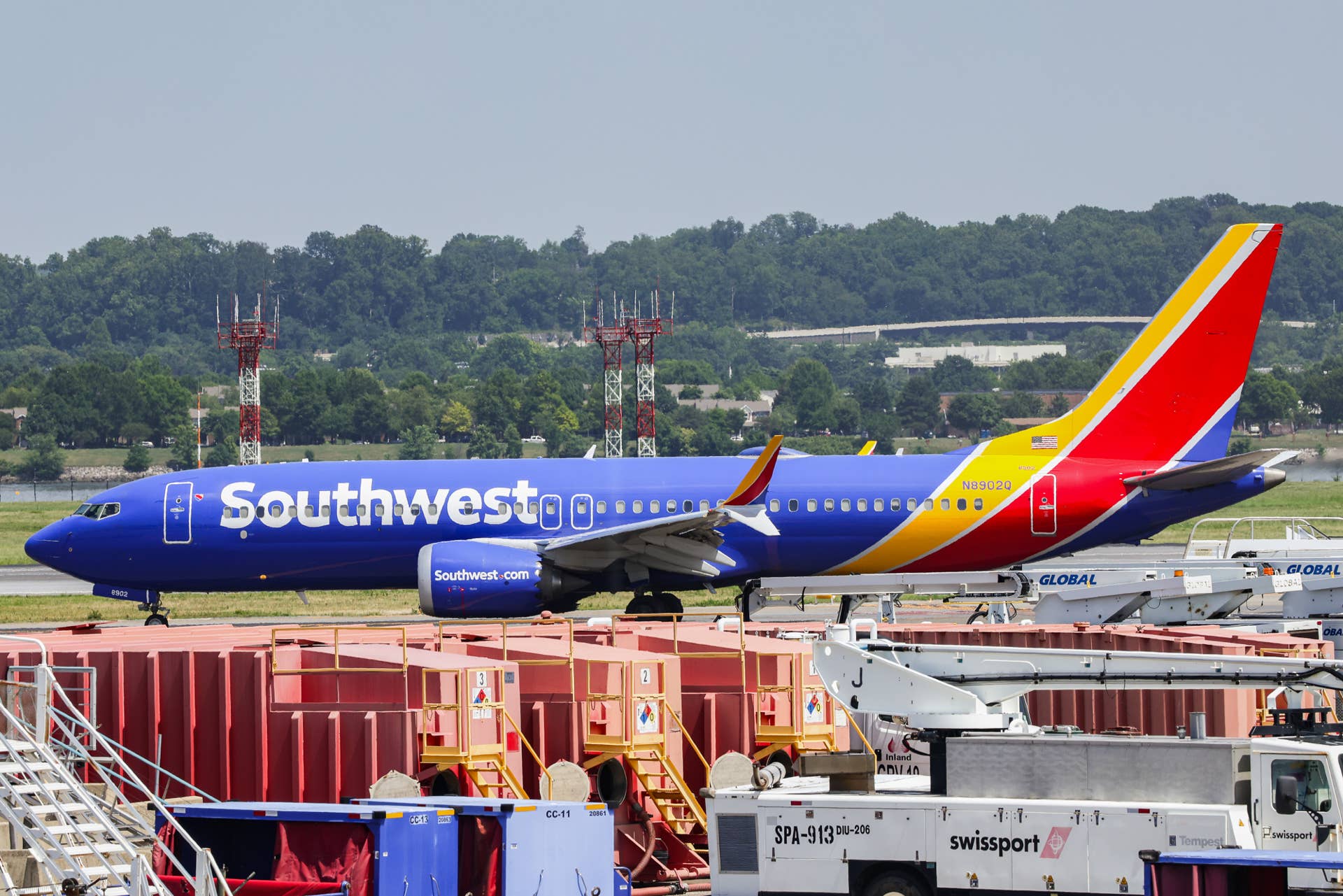 Morgan Stanley is bullish on Southwest Airlines stock.
Bloomberg&solGetty Images
Breaking down Southwest's numbers
Here’s how Southwest performed in Q1 of 2026.
- Revenue for the quarter ended in March hit $7.25 billion, up nearly 13% from a year earlier.
- Operating profit swung from a loss of $223 million a year ago to a $330 million profit, pushing the operating margin to 4.6% from negative 3.5%.
- Net income came in at $227 million versus a $149 million loss last year, and EBITDA more than quadrupled to $728 million.
- Operating cash flow reached $1.42 billion for the quarter, well above every one of the prior four quarters.
Total cash fell sharply to $3.33 billion from $8.13 billion a year earlier, mostly because Southwest has been aggressively buying back stock, about $1.25 billion worth in the latest quarter alone, and paying down debt.
Shareholder equity dropped to $6.88 billion from $9.37 billion for the same reason. None of that signals distress. Rather, it reflects a company returning excess cash it built up during the pandemic, exactly as Jordan described on the Bernstein call.
Total debt ticked up slightly, and the current portion of long-term debt rose to $851 million, worth watching but not alarming, given the cash generation trend.
Put together, Southwest looks like a company whose core operations are genuinely healthier than a year ago, even if its cash cushion is thinner by design.
That is a very different story from an airline papering over weak fundamentals with financial engineering.
Is LUV stock undervalued?
Analysts tracking LUV stock forecast the company will end 2030 with free cash flow of $2.91 billion, compared with an outflow of $831 million in 2025, according to Tikr.com data.
If Southwest Airlines stock is priced at 15x forward FCF, it could almost double over the next four years if we account for dividend reinvestments.
Out of the 15 analysts covering LUV stock, seven recommend “buy,” six recommend “hold,” and two recommend “sell.”
The average Southwest Airlines stock price target is $50.83, marginally higher than the current trading price.
Related: Southwest Airlines' CEO makes startling admission


Ayrıca Şunları da Beğenebilirsiniz

Stable Token Jumps 24.6% as Market Cap Crosses $771M: What’s Driving Volume?

Mastercard Launches Crypto Partnership Program with 85+ Firms


